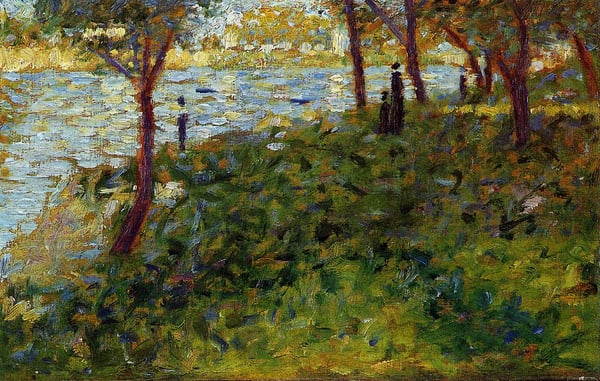
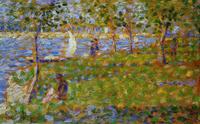
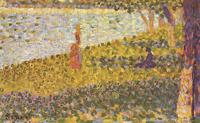
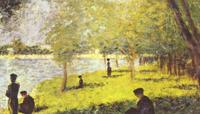
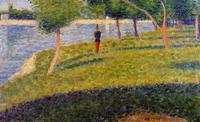
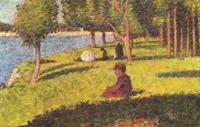
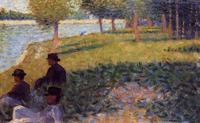
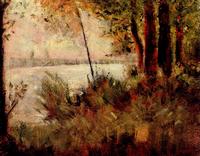
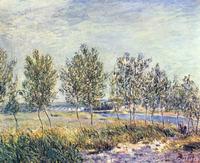
This study for Georges Seurat’s monumental masterpiece, A Sunday on La Grande Jatte, is a significant work within the Impressionist style, offering a rare glimpse into the artist’s meticulous preparatory process. Although Seurat is more famously associated with the Post-Impressionist development of Pointillism, this landscape adheres to classic Impressionist concerns: capturing the fleeting effects of light and atmosphere in a natural setting.
What makes Landscape with Figure. Study for 'La Grande Jatte' notable is its role as a direct preliminary sketch for one of the most iconic paintings of the 19th century. In this study, Seurat focuses on the essential elements of the scene—the interplay of sunlight on the grass, the dappled shadows beneath trees, and the calm presence of a solitary figure—without yet applying the rigid dot technique of the final canvas. Instead, the brushwork is looser and more spontaneous, typical of Impressionist landscape painting. The figure is rendered as a simple silhouetted form, emphasizing the overall harmony of color and atmosphere over detailed anatomy.
This work reveals Seurat’s deep engagement with Impressionist principles of optical mixing and broken color, even as he would soon push beyond them into a more systematic, scientific approach. For art historians, the study is crucial because it documents the evolution of Seurat’s vision: from a naturalistic, plein-air Impressionist sketch to the highly structured, pointillist composition of the finished La Grande Jatte. In this sense, the piece stands at a crossroads in art history, embodying the culmination of Impressionism while anticipating the revolutionary techniques of Neo-Impressionism.