
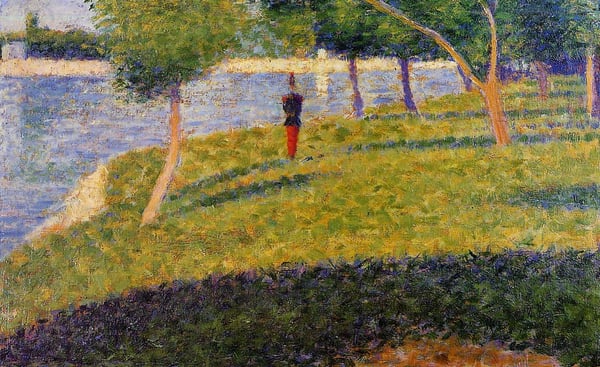
Expertenanalyse zu Georges Seurats Cadet From Saint-Cyr
Stil: Pointillism, Neo-Impressionism · Genre: landscape
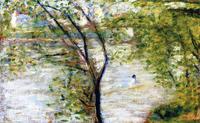
Expert Analysis: “Cadet From Saint‑Cyr” by Georges Seurat
As a seminal work of Neo‑Impressionism, Seurat’s Cadet From Saint‑Cyr exemplifies the artist’s revolutionary approach to color theory and optical blending. Although classified under the genre of landscape, the painting integrates a figural subject—a cadet—within a broader outdoor scene, reflecting Seurat’s interest in modern life and the harmonious fusion of human presence with nature.
Significance within Pointillism & Neo‑Impressionism:
- Systematic Technique: The painting is constructed entirely from small, distinct dots of pure pigment (pointillism), applied according to Seurat’s chromoluminarist principles. This method replaces traditional brushwork with a scientific approach to color mixture, where the viewer’s eye optically blends the dots to create luminous, vibrating tones.
- Color Theory in Practice: Seurat’s palette in this work likely adheres to the laws of simultaneous contrast and complementary colors. For instance, the cadet’s uniform might be built from blue‑orange juxtapositions, while the landscape employs greens, yellows, and purples to enhance depth and atmospheric effect.
- Balance of Figure and Environment: Though a landscape, the title foregrounds the cadet as a focal point. Seurat deliberately subverts the traditional hierarchy by treating the figure with the same pointillist matrix as the foliage and sky, achieving a unified, almost tapestry‑like surface. This blurs the boundary between subject and setting, a hallmark of Neo‑Impressionist ambition to render the totality of visual experience.
Art‑Historical Impact:
Cadet From Saint‑Cyr underscores Seurat’s departure from Impressionist spontaneity toward a more structured, intellectual art. The painting demonstrates how Neo‑Impressionism applied scientific color theories to elevate everyday scenes—here, a military student in a pastoral landscape—into rigorous, visually radiant compositions. It stands as a testament to Seurat’s dedication to refining optical perception through methodical precision, influencing later movements such as Fauvism and even early modern abstraction.
In summary, the work’s significance lies in its dual identity: a landscape that anchors a human figure, and a pointillist canvas where every dot is a deliberate act of color‑theory research. It is a quintessential Neo‑Impressionist statement, combining modernity, science, and timeless painterly beauty.
Museum / Gallery
Visuell ähnlich
20 Werke mit ähnlicher Komposition und Farbpalette
Study for 'A Sunday Afternoon on the Island of La Grande Jatte'
Georges Seurat
Seated figures
Georges Seurat
Study for 'La Grande Jatte'
Georges Seurat
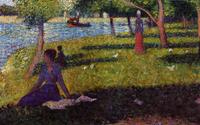
Seated and Standing Woman
Georges Seurat
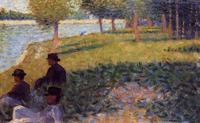
Three Men Seated
Georges Seurat
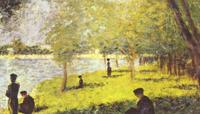
Study with Figures. Study for 'La Grande Jatte'
Georges Seurat
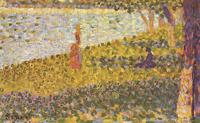
Women by the Water
Georges Seurat
Landscape with Figure. Study for 'La Grande Jatte'
Georges Seurat
Woman Fishing and Seated Figures
Georges Seurat
Sailboat
Georges Seurat
La Grande Jatte
Georges Seurat
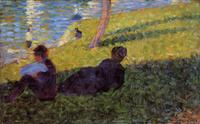
Study for "Un dimanche après midi à l'île de la Grande Jatte"
Georges Seurat
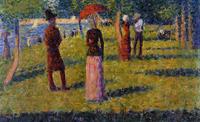
The Rope-Colored Skirt
Georges Seurat
White dog
Georges Seurat
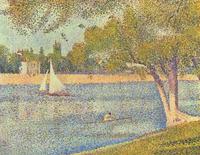
The river Seine at La Grande-Jatte
Georges Seurat
Primrose Hill, Regent's Park
Camille Pissarro
Banks of the Loing, Autumn
Alfred Sisley
Walnut Tree in a Thomery Field
Alfred Sisley
The Promenade at Argenteuil, Soleil Couchant
Claude Monet
A canoes
Georges Seurat