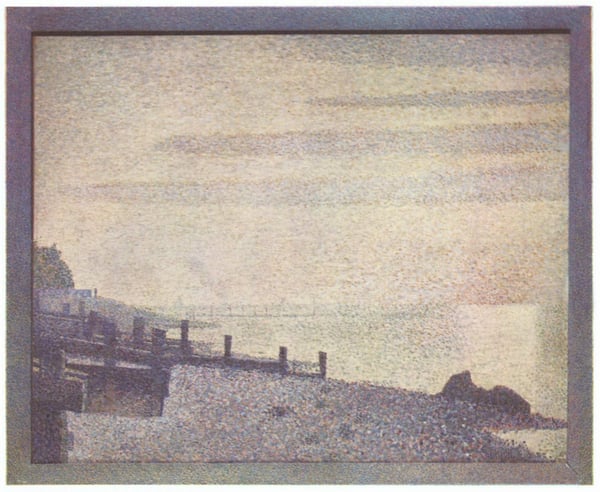
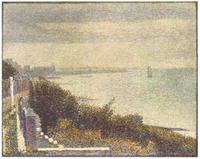
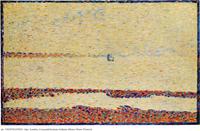
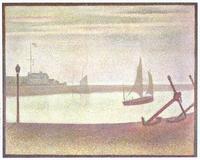
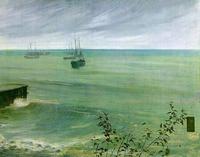
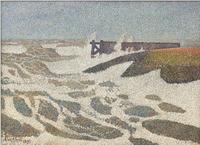
Georges Seurat’s Mouth of the Seine at Honfleur, evening stands as a quintessential example of his pioneering technique and the theoretical ambitions of Neo-Impressionism. Rendered in the Pointillist method, the painting consists of meticulously placed, separate dots of pure color that, when viewed from a distance, optically blend into a luminous and harmonious whole. This scientific approach to color and light—rooted in the color theories of Michel-Eugène Chevreul and Charles Blanc—marks a radical departure from traditional Impressionist brushwork.
As a landscape, the work captures the tranquil estuary at Honfleur at dusk, but its significance lies not in literal representation but in the systematic construction of atmosphere through complementary hues and tonal contrasts. The evening light is evoked not by mixing pigments on the palette, but by juxtaposing small touches of blue, orange, violet, and green, which the viewer’s eye fuses into a shimmering, vibrant surface. This method elevates the genre from mere observation to a controlled, almost scientific study of perception. Seurat’s dedication to this rigorous technique in a landscape setting demonstrates how Neo-Impressionism transformed even the most conventional subject into a manifesto of modern artistic theory.