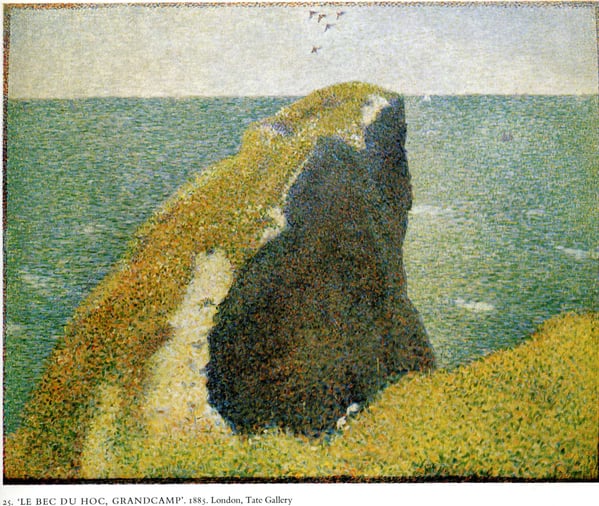
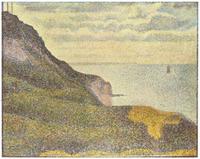
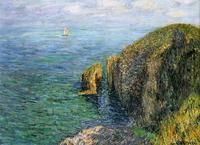
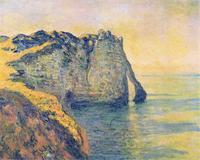
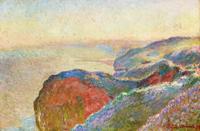
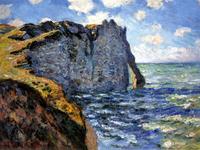
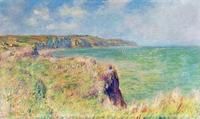
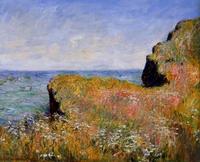
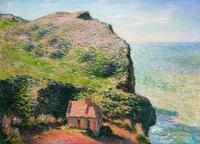
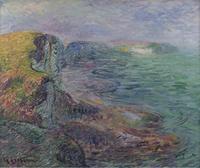
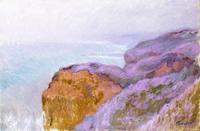
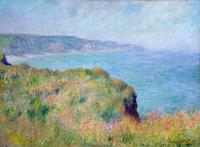
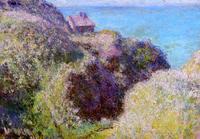
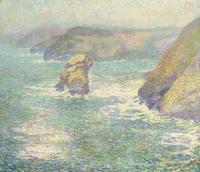
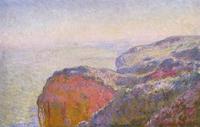
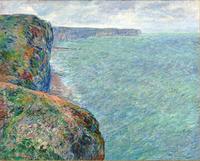
As an expert art historian, I analyze "The Bec du Hoc, Grandcamp" by Georges Seurat based solely on the provided facts: its style is Pointillism and Neo-Impressionism, and its genre is landscape.
The significance of this work lies in its exemplary representation of the core principles of Neo-Impressionism. Seurat, as the pioneer of Pointillism, applied a rigorous, scientific approach to color and composition. In this landscape, he would have systematically applied small, distinct dots of pure pigment—rather than mixing colors on a palette—to achieve vibrant luminosity and optical blending when viewed from a distance. This technique, known as divisionism, marks a radical departure from the intuitive brushwork of Impressionism, elevating landscape painting to a structured, almost analytical study of light and color. The subject—a coastal headland at Grandcamp—is not merely a scenic view but a vehicle for demonstrating how color and form could be deconstructed and rebuilt through dots. This work thus stands as a landmark in the evolution of modern art, showcasing the height of Neo-Impressionist theory in a serene yet scientifically rigorous landscape.