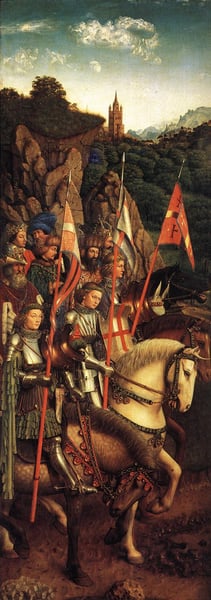
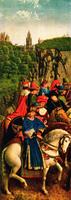
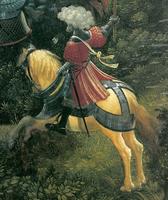
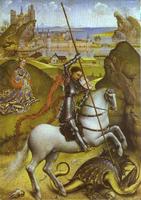
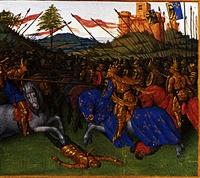
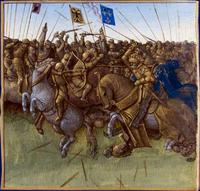
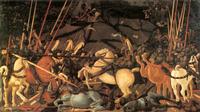
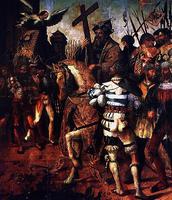
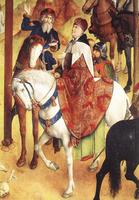
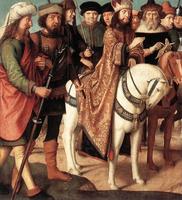
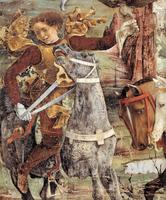
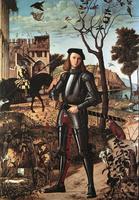
"The Soldiers of Christ" by Jan van Eyck—while not among his most documented works—is a significant example of Northern Renaissance history painting. Within this context, van Eyck’s unmatched technical mastery of oil paint allows for an unprecedented level of naturalistic detail: the gleam of armor, the texture of fabric, and the play of light across faces all serve to ground a religious or allegorical narrative in tangible reality. The title itself, "Soldiers of Christ," evokes the fusion of earthly chivalry with spiritual warfare, a theme central to the period’s devotional and political imagery. Van Eyck would have employed his characteristic symbolic layering—objects, gestures, and colors carrying multiple meanings—to transform a historical or biblical event into a meditation on faith, duty, and salvation. The work’s significance lies in how it pushes the boundaries of the history genre: it does not simply illustrate a story but immerses the viewer in a vividly realized, morally charged world, prefiguring the psychological depth and material richness that would define early Netherlandish painting.