Expert Analysis of The Battle of San Romano by Paolo Uccello
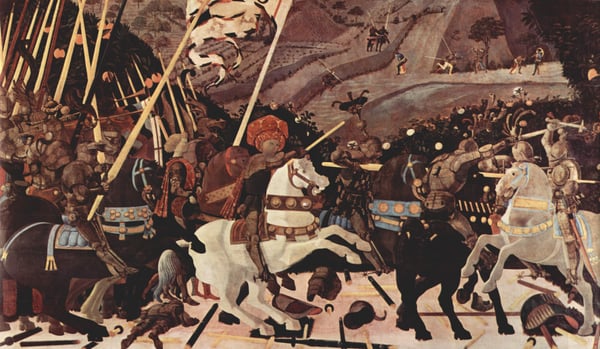
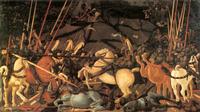
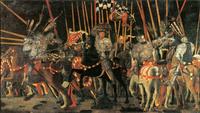
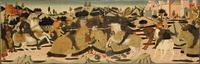
As an Early Renaissance battle painting, The Battle of San Romano exemplifies a pivotal shift in the depiction of conflict—moving from medieval conventions of symbolic, heraldic chaos toward a structured, mathematically ordered composition. The work's significance lies in how Uccello harnessed the period’s emerging fascination with linear perspective and geometric form to transform the battle genre into a stage for spatial experimentation.
Within the Early Renaissance, artists increasingly sought to reconcile naturalistic observation with rational design. Here, Uccello uses the chaos of cavalry and foot soldiers not merely as a narrative of violence but as a vehicle to demonstrate perspective: lances, banners, and fallen warriors create receding lines that pull the eye into depth. The flattened, almost decorative treatment of color and pattern (e.g., the precise, toy-like horses) reflects the period’s lingering Gothic influence, while the rigorous organization of the scene anticipates the High Renaissance passion for harmony.
Thus, the painting is significant as a fusion of two impulses—the battle genre’s raw energy and the Early Renaissance drive for order—making it a landmark in the evolution of both perspective and military painting.