Expert analysis of Pietro Perugino’s Combat of Love and Chastity
Style: High Renaissance · Genre: allegorical painting
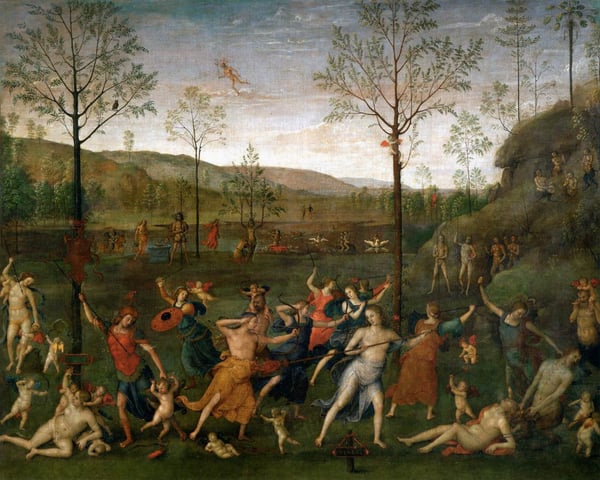
This allegorical masterpiece, Combat of Love and Chastity (commissioned around 1503–1505 for Isabella d’Este’s private studiolo in Mantua), stands as a quintessential example of the High Renaissance’s balance between classical form and intellectual allegory. Perugino, the Umbrian master who taught Raphael, here demonstrates the period’s core virtues: spatial harmony, precise linear perspective, and a serene, idealized treatment of the human figure.
Significance within the High Renaissance
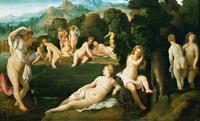
The painting embodies the era’s shift toward complex, multi-figure compositions rooted in classical mythology and Neoplatonic philosophy. The “combat” is not a chaotic battle but a highly ordered, almost choreographed tableau—figures of Love (often identified with Venus and Cupid) are confronted by Chastity (Minerva, or the personified Diana), each side featuring graceful, contrapposto poses derived from antique sculpture. Perugino’s characteristic soft modeling, luminous landscape, and subdued palette synthesize the Florentine concern for disegno (draftsmanship) with the Umbrian love of atmospheric space. Note the vanishing-point perspective drawing the eye through the arched landscape—a device that creates a window-like view, inviting the viewer into the allegorical arena.
Allegorical Depth and Courtly Context
Commissioned by one of the most learned women of the Renaissance, the painting functions as both a moral lesson and a celebration of intellectual virtue. The battle symbolizes the triumph of chastity (or reason) over sensual love—a theme popular in humanist courts. Yet Perugino avoids didactic stiffness; his figures are poised, their gestures flowing with a rhythmic grace that anticipates Raphael’s School of Athens. The work is significant precisely because it merges narrative clarity with poetic ambiguity: Love’s arrows are deflected, but the victors bear the same classical beauty as the vanquished, suggesting that the Renaissance mind saw virtue and passion as equally noble forces in the human soul.
Stylistic Legacy
Within Perugino’s own oeuvre, this painting marks a late-career high point where his signature devotional sweetness yields to a more dynamic, secular drama—a bridge between early Renaissance gold-ground altarpieces and the full High Renaissance monumentality of Michelangelo and Raphael. The work’s serene atmosphere, subtle chiaroscuro, and precisely calibrated geometry (the figures arranged in a flattened frieze-like plane) make it a definitive statement of the High Renaissance’s belief that moral conflict could be expressed through perfect formal harmony.
Museum / Gallery
Visually similar
20 works with related composition and palette
The Combat of Love and Chastity
Andrea Mantegna
The Discovery of Honey by Bacchus
Piero di Cosimo
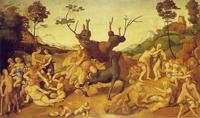
The Misfortunes of Silenus
Piero di Cosimo
LE PARADIS TERRESTRE
Frans Pourbus the Elder
Orpheus
Giovanni Bellini

Adam and Eve in the Garden of Eden
Lucas Cranach the Elder
The Golden Age
Lucas Cranach the Elder
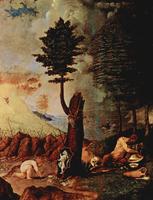
Allegory (Allegory of Prudence and Wisdom)
Lorenzo Lotto
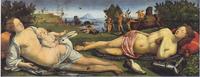
Venus, Mars, and Cupid
Piero di Cosimo
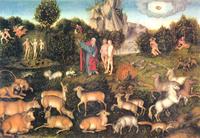
Paradise
Lucas Cranach the Elder
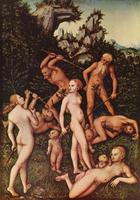
The Silver Age
Lucas Cranach the Elder
Terrestrial Paradise
Hieronymus Bosch
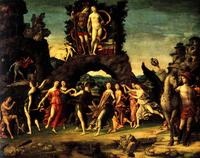
The Parnassus: Mars and Venus
Andrea Mantegna
Law and Grace
Lucas Cranach the Elder
The Golden Age
Lucas Cranach the Elder
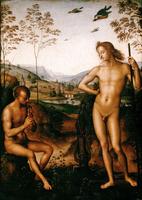
Apollo and Marsyas
Pietro Perugino
Three Ages of Man and Three Graces
Hans Baldung
The Triumph of Silenus
Nicolas Poussin
Haywain (detail)
Hieronymus Bosch
Diana and Callisto
Palma Vecchio