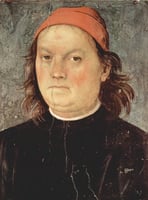
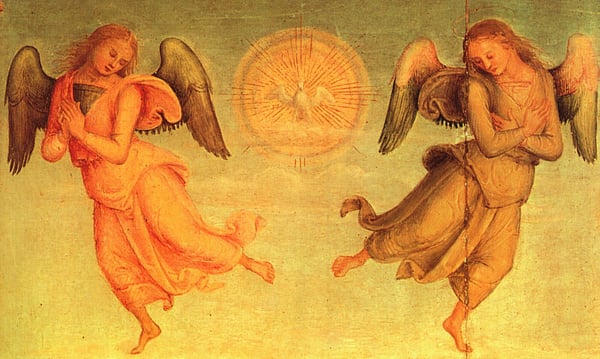
St. Augustine Polyptych (detail)
Analisi esperta di St. Augustine Polyptych (detail) di Pietro Perugino
Stile: Early Renaissance · Genere: religious painting
Artwork Analysis: "St. Augustine Polyptych (detail)" by Pietro Perugino
Style & Period Significance
As an Early Renaissance religious painting, this detail from Perugino's polyptych exemplifies the period's transition from medieval formalism to naturalism and spatial coherence. The polyptych format itself—a multi-panel altarpiece—was a traditional structure, but Perugino’s handling demonstrates the Early Renaissance obsession with balanced composition, clear geometry, and atmospheric perspective.
Artist’s Contribution
Pietro Perugino, a master of the Umbrian school, was celebrated for his ability to infuse sacred figures with serene grace and harmonious order. In this detail, the careful arrangement of figures and drapery reflects his signature approach: soft modeling, subtle chiaroscuro, and a calm, devotional mood that foreshadows the High Renaissance ideals of Raphael (his student).
Religious & Iconographic Focus
The work’s religious function—likely part of a larger altarpiece dedicated to St. Augustine—centers on communicating theological clarity. Even in a detail, Perugino’s precise linearity and delicate color harmonies direct the viewer’s eye toward a luminous, spiritual focal point, reinforcing the painting’s role in private or communal worship.
Why It Matters
This detail is significant because it captures the essence of Early Renaissance innovation: blending medieval polyptych conventions with a newfound humanism and spatial unity. Perugino’s influence on the development of Renaissance compositional principles—particularly his use of perspective and idealized figures—makes the St. Augustine Polyptych a crucial document in the evolution of Western religious art.
Visivamente simili
20 opere con composizione e palette affini
Angels (detail)
Pietro Perugino
Archangel Gabriel
Piero della Francesca
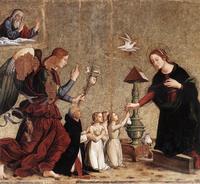
Annunciation with Cardinal Torquemada
Antoniazzo Romano
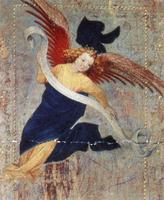
Angel (from Altar of Philip the Bold)
Melchior Broederlam
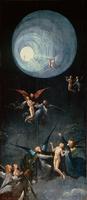
Ascent of the Blessed
Hieronymus Bosch
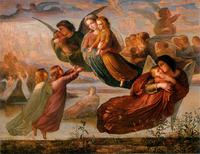
Poème de l'âme 5: Souvenir du ciel
Louis Janmot
The Angel of the Annunciation
Lorenzo Lotto
Barbara-Altar (Schwaigern), detail
Jerg Ratgeb
Poème de l'âme 2: Le Passage des âmes
Louis Janmot
Ascension of Saint Mary Magdalene
Antonio del Pollaiolo
Tobiolo E I Tre Arcangeli
Filippino Lippi
Annunciazione (detail)
Palma il Giovane
Pala di Sant Agostino (Arcangel Gabriel)
Pietro Perugino
Pala di San Francesco al Monte (The Coronation of the Virgin)
Pietro Perugino
Die Drei Erzengel Mit Dem Kleinen Tobias
Francesco Botticini
The Almighty with Prophets and Sybils
Pietro Perugino
The Annunciation
Sandro Botticelli
Vallombrosa Altar (detail)
Pietro Perugino
Angel playing music
Franz Ittenbach
St.Catherine of Alexandria
Henri Lehmann