Expert analysis of Pietro Perugino’s The Adoration of the Magi
Style: Early Renaissance · Genre: religious painting
Expert Analysis of "The Adoration of the Magi" by Pietro Perugino
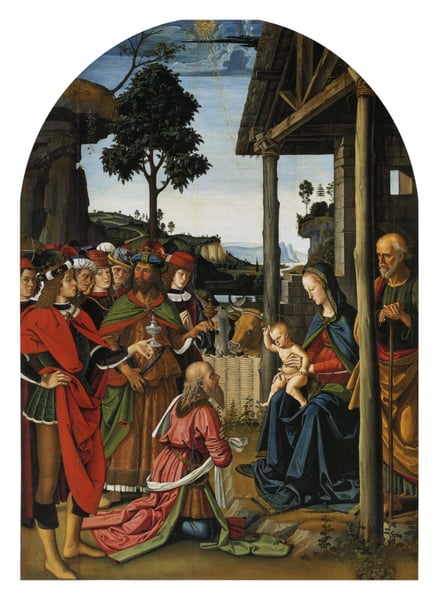
As an Early Renaissance religious painting by Pietro Perugino, this work epitomizes the era’s shift toward clarity, harmonious composition, and serene naturalism. Perugino, a leading master of the Umbrian school, infuses the traditional Adoration narrative with a sense of balanced order and calm dignity that became hallmarks of the period.
Stylistic Significance
The painting’s structure likely employs the precise linear perspective and carefully calibrated spatial depth that defined Early Renaissance innovations. Figures are arranged in a clear, symmetrical composition—the Virgin and Child at the center, the Magi presenting gifts in a measured, reverent procession—allowing the viewer’s eye to move effortlessly through the scene. This clarity reflects a broader Renaissance ambition to create rational, believable pictorial space, moving beyond the flat, symbolic arrangements of Gothic art.
Emotional and Devotional Impact
Perugino’s figures possess a gentle, idealized beauty and a soft, diffused light that evokes spiritual calm rather than dramatic emotion. The tender interaction between the Magi and the Christ Child emphasizes humility and adoration, a key devotional goal of religious painting at the time. The landscape—likely a tranquil, rolling vista framed by delicate trees—serves as a quiet backdrop, reinforcing the sacred moment’s timelessness.
Place Within Early Renaissance
Perugino’s work bridges the meticulous naturalism of earlier Quattrocento artists and the grand, harmonious style that would influence his renowned pupil Raphael. Here, the combination of geometrical order, atmospheric softness, and restrained piety makes the painting a quintessential example of how Early Renaissance art used perspective and humanist ideals to elevate religious narrative. Its significance lies in its perfect balance of compositional rigor and lyrical tenderness—a synthesis that helped define the era’s visual language.
Museum / Gallery
Visually similar
20 works with related composition and palette
Adoration of the Kings (Epiphany)
Pietro Perugino
Moses's Journey into Egypt and the Circumcision of His Son Eliezer (detail)
Pietro Perugino
Adoration of the Magi
Geertgen tot Sint Jans
Adoration of the Magi, central panel of the Triptych of the Adoration of the Magi
Hans Memling
The Adoration of the Magi
Domenico Ghirlandaio
The Mystic Marriage of St. Catherine
Lucas Cranach the Elder
Feast of the Rosary
Albrecht Durer
Nativity
Martin Schongauer
Adoration of the Magi
Defendente Ferrari
Adoration of the Magi
Geertgen tot Sint Jans
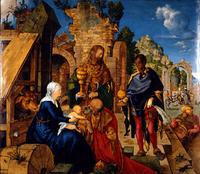
The Adoration of the Magi
Albrecht Durer
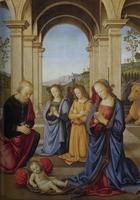
Polyptych Albani Torlonia (particular detail)
Pietro Perugino
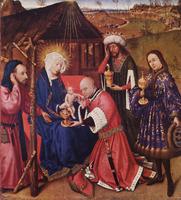
Adoration of the Magi
Jacques Daret
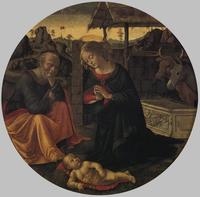
Adoration of the Child
Domenico Ghirlandaio
The Nativity
Andrea Mantegna
Holy Family with Two Donors
Vittore Carpaccio
Adoration Of The Child With Saints
Filippo Lippi
The middle panel of The Pearl of Brabant: Adoration of the Magi
Dirk Bouts
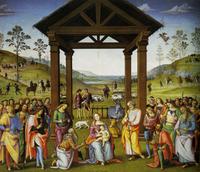
The Adoration of the Magi
Pietro Perugino
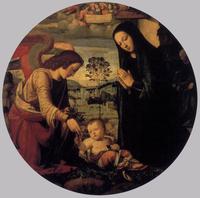
Adoration of the Child with Angel
Mariotto Albertinelli