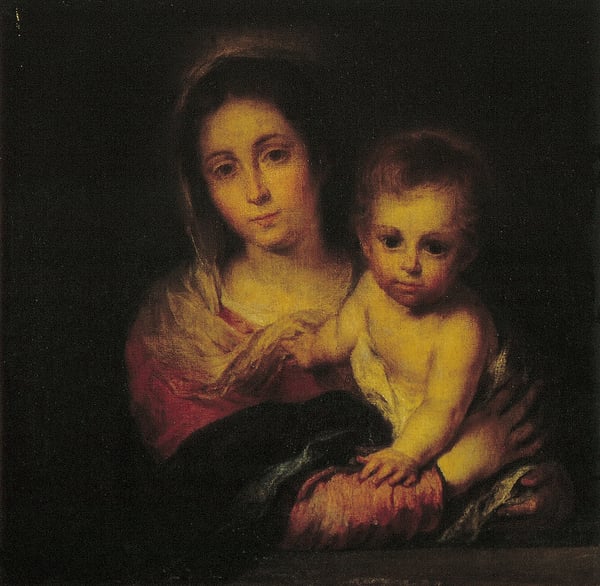
Bartolome Esteban Murillo sanatçısının Madonna with a Napkin eseri hakkında uzman analizi
Tarz: Baroque · Tür: religious painting
Expert Analysis: "Madonna with a Napkin" by Bartolomé Esteban Murillo
As a masterwork of the Spanish Baroque, Madonna with a Napkin exemplifies Murillo’s distinctive ability to blend divine grandeur with intimate, human tenderness—a hallmark that set him apart from the more dramatic, tenebrist style of contemporaries like Zurbarán or Ribera. The painting’s significance lies in its gentle naturalism and its subtle subversion of traditional Marian iconography through a humble, everyday object: the napkin.
Stylistic and Period Significance
Murillo’s Baroque is one of suavidad (softness) and emotional accessibility. Rather than emphasizing the suffering or ecstatic mysticism common in Counter-Reformation art, Murillo portrays the Virgin as a nurturing, approachable mother. The napkin—a simple cloth, possibly meant to evoke the swaddling clothes of the Christ Child or the linen of the altar—serves as a poignant reminder of the Incarnation’s material reality. It humanizes the sacred, making the celestial feel present in the domestic sphere. This aligns with the Spanish Baroque’s goal of making religious devotion accessible to everyday believers.
Composition and Technique
Murillo employs a warm, golden palette and soft chiaroscuro, creating a gentle radiance around the Madonna’s face and the Christ Child. The napkin, draped across her lap or held in her hand, becomes a focal point that anchors the composition in tactile reality. The Virgin’s downcast eyes and serene smile convey a tender, almost personal emotion, while the infant Christ reaches toward the cloth—a gesture that suggests both playfulness and the foreshadowing of His eventual burial shroud. The brushwork is fluid and delicate, typical of Murillo’s late style, blending sfumato with subtle highlights that seem to emanate from within the figures.
Iconographic Innovation
While the title “Madonna with a Napkin” might suggest a genre element, it is a deeply theological work. The napkin functions as a vanitas symbol of Christ’s humanity and mortality, yet it is rendered with such affection that it avoids grimness. Murillo often painted the Immaculate Conception and the Holy Family as intimate, quiet scenes; here, he reframes the classic Madonna and Child by elevating a mundane textile to a sacred attribute. This innovation anticipates the rococo’s domestic religious scenes and influenced later artists like Goya in their focus on ordinary life as a window to the divine.
Legacy
In the context of Sevillian Baroque, Murillo was celebrated for his ability to make the heavenly feel neighborly. Madonna with a Napkin remains a quintessential example of his “sky-earth” synthesis: a picture that invites prayer not through awe, but through familiarity. Its gentle realism and symbolic economy make it a pivotal work in the shift from high Baroque drama to a more intimate, sentimental religious aesthetic—one that would resonate for centuries in both Spanish and European art.
Museum / Gallery
Görsel olarak benzer
İlişkili kompozisyon ve renk paletine sahip 20 eser
DIE MADONNA MIT DEM JESUSKNABEN
Jacopo Amigoni
Virgin and Child
Bartolome Esteban Murillo
Madonna and Child
Jacopo Amigoni
Madonna and Child
Pompeo Batoni
Mrs. Joseph Martin and her Son Charles
Joshua Reynolds
Madonna and Child with Infant John the Baptist
Domenico Beccafumi
MARIA MIT DEM KIND UND DEM JOHANNESKNABEN
Hans Rottenhammer I
Madonna
Theodor van Thulen
Virgin with Child
Bartolome Esteban Murillo
Madone Et Enfant Avec Deux Anges
Giambattista Pittoni
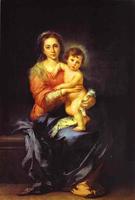
Madonna and Child
Bartolome Esteban Murillo
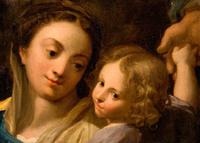
Madonna and Child (after Correggio)
John Graham-Gilbert
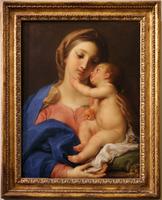
Madonna col bambino
Pompeo Batoni
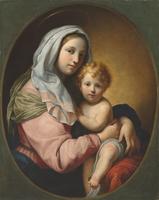
Onorio Marinari Virgin and Child, in a Feigned Oval
Onorio Marinari
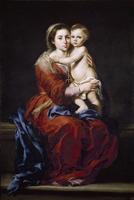
The Virgin of the Rosary
Bartolome Esteban Murillo
Madonna and Child
Correggio
Madonna and Child in a Floral Garland
Jan Brueghel the Elder
Mrs. Benjamin West and Her Son Raphael
Benjamin West
Madonna and Child
Parmigianino
Madonna of the Goldfinch
Giovanni Battista Tiepolo