Analisi esperta di The Martyrdom of St. Andrew di Bartolome Esteban Murillo
Stile: Baroque · Genere: religious painting
Expert Analysis: "The Martyrdom of St. Andrew" by Bartolome Esteban Murillo
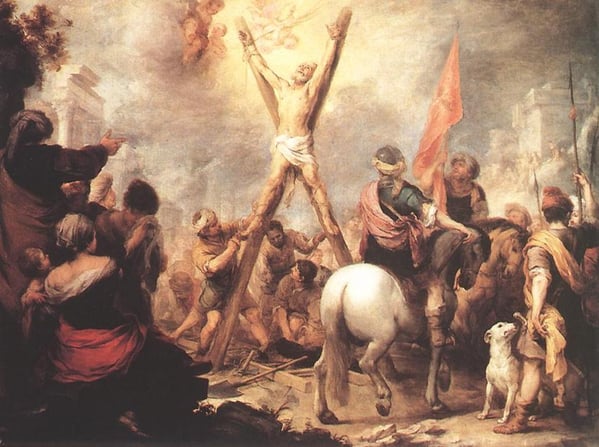
Executed in the Spanish Baroque tradition, Murillo’s The Martyrdom of St. Andrew exemplifies the Counter-Reformation’s demand for emotionally resonant, accessible religious imagery. As a Baroque religious painting, its significance lies in how Murillo balances the dramatic intensity typical of the period with his own signature tenderness and naturalism, creating a scene that is both visceral and spiritually uplifting.
The work captures the saint’s crucifixion on an X-shaped cross, a moment of supreme agony yet serene faith. True to Baroque principles, Murillo employs strong chiaroscuro—contrasts of light and shadow—to direct the viewer’s focus on Andrew’s illuminated face and the cross, emphasizing his martyrdom as a glorious, not gruesome, event. The composition is dynamic, with diagonal lines of the cross and the surrounding figures’ gestures pulling the eye upward, reinforcing the spiritual ascent.
What makes this painting significant is Murillo’s departure from the more overtly violent depictions of martyrdom common among his contemporaries (such as Zurbarán or Ribera). Here, the pathos is mitigated by a soft, almost lyrical quality: Andrew’s expression is one of ecstatic acceptance, and the heavenly light breaking through the dark sky suggests divine grace. This approach—combining Baroque drama with a gentle, humanizing warmth—allowed Murillo to make the Counter-Reformation’s ideals of saintly sacrifice relatable to a wide audience. The painting thus stands as a key example of Spanish Baroque religious art that prioritized emotional connection and spiritual optimism over stark terror, securing Murillo’s reputation as a master of accessible piety.
Museum / Gallery
Visivamente simili
20 opere con composizione e palette affini
Christ on the Cross Between the Two Thieves
Peter Paul Rubens
Crucifixion
Giovanni Battista Tiepolo
Golgotha
Anthony van Dyck
Christ on the Cross
Peter Paul Rubens
The Elevation Of The Cross
Rembrandt
Crucifixion (detail)
Palma il Giovane
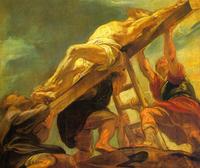
The Raising of the Cross
Peter Paul Rubens
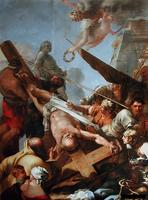
Le crucifiement de Saint Pierre
Sebastien Bourdon
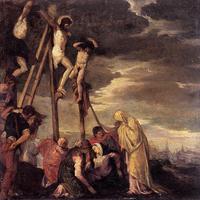
Calvary (after Veronese)
Berthe Morisot
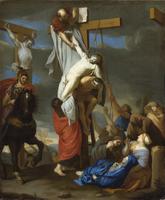
The Descent from the Cross
Charles Le Brun
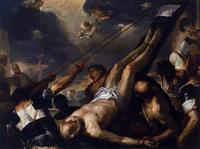
Crucifixion of Saint Peter
Luca Giordano
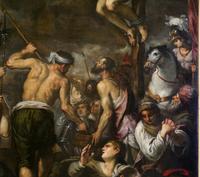
Crucifixion (detail)
Palma il Giovane
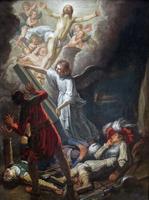
The Resurrection of Christ
Pieter Lastman
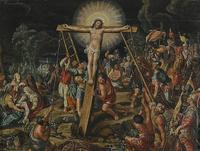
Kreuzaufrichtung
Christoph Schwarz
Crucifixion (detail)
Palma il Giovane
Crucifixion
Palma il Giovane
Christ on the Cross
Eugene Delacroix
The Brazen Serpent
Benjamin West
The Martyrdom of Sts Placidus and Flavia
Francesco Solimena
The Raising of the Cross
Peter Paul Rubens