Expert analysis of Masaccio’s The Holy Trinity
Style: Early Renaissance · Genre: religious painting, trompe-l'œil
Expert Analysis of "The Holy Trinity" by Masaccio
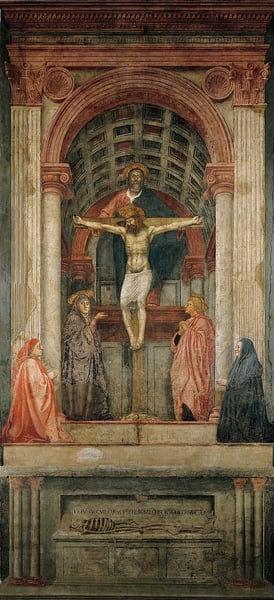
Masaccio’s The Holy Trinity (c. 1427) is a foundational masterpiece of the Early Renaissance, executed as a fresco in the Florentine church of Santa Maria Novella. Its significance lies in the revolutionary integration of trompe‑l’œil illusionism with profound religious narrative—a combination that redefined spatial representation in painting.
Pioneering Linear Perspective
The work is celebrated for its mathematically precise use of one-point linear perspective, a technique Masaccio likely developed in dialogue with the architect Brunelleschi. The vanishing point is set at the viewer’s eye level, just below the scene, creating a believable, continuous space that appears to recede into the wall. This illusionistic depth—a hallmark of the Early Renaissance—makes the painted architecture (a barrel‑vaulted chapel) seem physically real, as if the viewer is looking into an actual niche. By embedding the sacred scene in a rational, measurable space, Masaccio married theological symbolism with the newly rediscovered principles of perspective, making the divine visually accessible to the human eye.
Trompe‑l’Œil and Spatial Ambiguity
The trompe‑l’œil effect extends beyond architecture. The skeleton at the base, with its chilling inscription “Io fu’ già quel che voi siete, e quel ch’io son voi anco sarete” (“I once was what you are, and what I am you will also be”), appears to rest on a ledge that projects into the viewer’s space. This device blurs the boundary between painted world and real church interior, forcing the beholder to confront mortality while simultaneously participating in the holy vision. The donors—kneeling on either side of the cross—are rendered in naturalistic proportions, their solidity enhancing the illusion that they inhabit the same dimensional realm as the Trinity above.
Religious and Humanist Synthesis
As a religious painting, the work presents a layered theological message: the Father supports the crucified Son, the dove of the Holy Spirit hovers between them, and the Virgin and Saint John stand witness below. This hierarchical composition, anchored in a convincing three‑dimensional setting, reflects the Early Humanist concern for fusing spiritual truth with empirical observation. The fresco’s placement over a side altar—visually aligned with the actual altar below—further integrates the painted chapel with the liturgical space, making the miraculous present within the worshipper’s immediate environment.
Enduring Influence
Masaccio’s Trinity fundamentally changed the course of Western painting. Its systematic perspective became a model for later Renaissance artists (including Leonardo and Raphael), while its combination of illusionism and sacred subject matter set a new standard for devotional art. The fresco remains a key example of how the Early Renaissance transformed medieval pictorial conventions into a naturalistic, psychologically engaging language—one that continues to captivate viewers as both a technical tour de force and a deeply moving meditation on faith and mortality.
Museum / Gallery
Visually similar
20 works with related composition and palette
Crucifixion and Saints
Andrea del Castagno
Loggia (the Founding of Rome)
Gentile da Fabriano
Madonna and Child with St. Sebastian and St. Julian
Domenico Ghirlandaio
The Crucifixion
Pietro Perugino
Crucifixion
Andrea del Castagno
Annunciation
Filippo Lippi
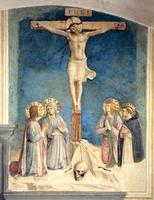
Crucifixion with the Virgin and Sts. Cosmas, John the Evangelist and Peter Martyr
Fra Angelico
St. Augustine Leaving His Mother
Benozzo Gozzoli
Tabernacle of the Visitation: Expultion of Joachim from the Temple
Benozzo Gozzoli
Birth and Naming St. John
Filippo Lippi
Saint Lawrence Receiving the Treasures of the Church from Pope Sixtus II
Fra Angelico
The Pazzi Crucifixion
Pietro Perugino
Dead Christ Supported by Mary and St. John the Evangelist
Filippo Lippi
The Annunciation
Domenico Ghirlandaio
Pietà
Filippo Lippi
Annunciation
Piero della Francesca
Pala di Monteripido
Pietro Perugino
Portrait of the Donor Giovanni Tornabuoni
Domenico Ghirlandaio
The Confirmation of the Olivetan Order by the Bishop of Arezzo
Il Sodoma
Pietà
Carlo Crivelli