Expert analysis of Camille Corot’s Banks of a Pond in Normandy
Style: Realism · Genre: landscape
Expert Analysis: "Banks of a Pond in Normandy" by Camille Corot
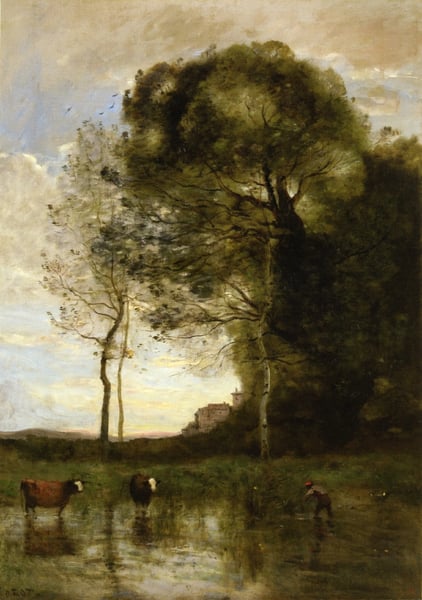
Camille Corot’s Banks of a Pond in Normandy (c. 1850s–1860s) stands as a quintessential example of how French Realist landscape painting transformed nature into a vehicle for quiet contemplation. Though firmly rooted in the Realist tradition—with its unidealized, direct observation of the rural countryside—the work also reveals Corot’s unique ability to infuse a scene with a poetic, almost meditative mood. This balance places him at the crossroads of Realism and the emergent Impressionist sensibility.
Stylistic and Historical Significance
Corot deliberately chose a seemingly ordinary subject: the edge of a pond, framed by modest trees and the soft horizon of the Normandy region. Unlike the dramatic ruins or heroic vistas favored by earlier Neoclassical painters, Corot focuses on the ephemeral play of light and atmosphere. The painting’s hallmark is its silvery, muted palette —a signature of Corot’s mature period—through which he conveys the cool air and dappled light of a temperate afternoon. Soft greens, grays, and pale blues are layered with subtle tonal transitions, creating a unified, hazy atmosphere that dissolves sharp outlines.
This approach was revolutionary for its time. While Realists like Gustave Courbet emphasized the tangible solidity of the natural world, Corot used a more delicate facture—broad, feathery brushstrokes and a thin application of paint—to suggest rather than define forms. The reflection of trees in the pond is rendered with blurred strokes that anticipate the looser handling of the Impressionists. Indeed, Corot’s landscapes directly influenced Manet, Monet, and Sisley, who admired his ability to capture a “first impression” of a site.
Composition and Realist Principles
Despite its softness, the composition is carefully structured. A large tree on the left creates a repoussoir, leading the eye diagonally across the pond toward a distant rise of land. A tiny, solitary figure—fisherman or wanderer—lends a quiet human scale to the scene, reminding us of the Realist commitment to depicting everyday life. Yet this figure is not an anecdotal character; it is a near-silhouette that serves as a note of melancholy, a theme Corot often described as the “soul” of a landscape.
Legacy
Banks of a Pond in Normandy exemplifies why Corot is considered the father of modern landscape painting. He demonstrated that a humble, unremarkable patch of water and foliage could be elevated into a work of profound serenity and truth. By prioritizing tonal harmony, atmospheric unity, and the subjective experience of a place, Corot opened the door for the Impressionists’ plein-air experiments while remaining anchored in the Realist reverence for observed fact. This painting is not merely a view of Normandy—it is a meditation on light, memory, and the transient beauty of the natural world.
Museum / Gallery
Visually similar
20 works with related composition and palette

Souvenir of Italy
Camille Corot
Souvenir of Brittany
Camille Corot
Cowherd in a Dell, Souvenir of Brittany
Camille Corot

Ville d'Avray, Cowherd in a Clearing near a Pond
Camille Corot
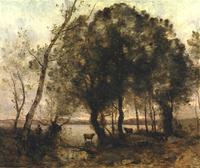
The Lake
Camille Corot
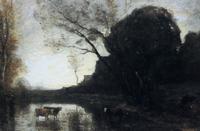
Italian Monk Reading
Camille Corot

The Goatherds of Castel Gandolfo
Camille Corot

Fishermen in a Boat
Camille Corot
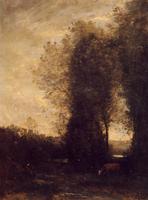
A Cow and its Keeper
Camille Corot

Le Gue (Cows on the Banks of the Gue)
Camille Corot
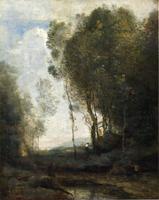
The Edge of the Forest
Camille Corot
Waterfall on the Romagnes
Camille Corot

The Ferryman Tying his Boat
Camille Corot
The Walk around the Pond
Camille Corot

A Ford with Large Trees
Camille Corot

Pond with Dog
Camille Corot
Shepherd Resting
Camille Corot

The Ponds of Ville d'Avray
Camille Corot
Goatherd Standing, Playing the Flute under the Trees
Camille Corot

Morning
Camille Corot