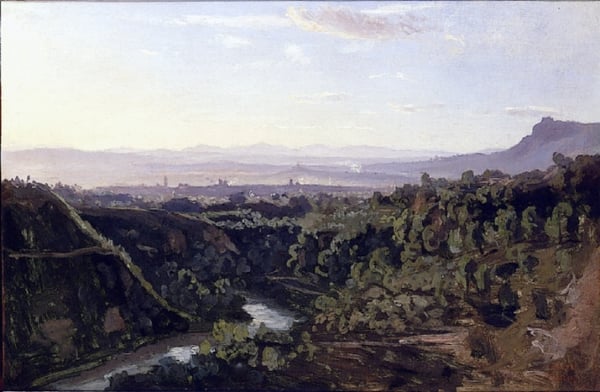
Bell Tower of the Church of Saint Paterne at Orleans
Details
Expert analysis of Camille Corot’s Bell Tower of the Church of Saint Paterne at Orleans
Style: Realism · Genre: landscape
Expert Analysis: "Bell Tower of the Church of Saint Paterne at Orleans" by Camille Corot
As a seminal work within the Realist landscape tradition, Camille Corot’s Bell Tower of the Church of Saint Paterne at Orleans exemplifies the movement’s commitment to depicting ordinary, unidealized scenes with perceptual honesty. While Corot is often celebrated as a bridge between Neoclassical structure and Impressionist light, this painting underscores his role in forging a distinctly Realist approach to landscape.
Significance within Realism:
-
Direct Observation over Idealization: Corot abandons the grand, mythologized landscapes of earlier periods, instead focusing on a specific, recognizable locale—the bell tower of a modest parish church in Orleans. This choice reflects Realism’s insistence on the everyday as worthy of artistic attention. The tower is not dramatized or made heroic; it sits quietly within its surroundings, anchored by the natural light and atmosphere of the moment.
-
Tonal Harmony and Atmospheric Truth: Corot’s signature soft, silvery palette and subdued contrasts serve not to beautify but to capture the actual quality of light and air. The bell tower is rendered with careful observation of how morning or afternoon light filters through the atmosphere, creating a unified tonality that feels more true to lived experience than the sharp, staged lighting of academic landscapes.
-
Compositional Restraint: The composition is deliberately simple—a vertical architectural element offset by horizontal planes of sky, foliage, and perhaps a pathway or riverbank. This restraint marks a rejection of dramatic perspective or staged foregrounds. Instead, Corot invites the viewer into a serene, unhurried encounter with the place itself, aligning with Realism’s privileging of the actual over the artificial.
-
Transitional Influence: Although Corot’s work retains a classical sense of balance, his focus on a specific, unglamorous structure and the transient effects of atmosphere directly paved the way for later Realists and early Impressionists. The painting stands as a quiet manifesto: the ordinary landscape, observed with integrity, holds as much artistic weight as any historical or mythological scene.
In essence, Bell Tower of the Church of Saint Paterne at Orleans is significant because it demonstrates how Corot used the tenets of Realism—truth to site, subdued naturalism, and atmospheric precision—to elevate a humble church tower into a study of presence, light, and stillness. It is a masterclass in seeing without embellishment.
Visually similar
20 works with related composition and palette
Cliffs on the Guadalupe
Robert Julian Onderdonk

Cañada de Metlac
Jose Maria Velasco
Valley in the Auvergne
Theodore Rousseau
Mount Soracte
Camille Corot
Mont Soracte
Camille Corot
The Roman Odalisque (Marietta)
Camille Corot
River Voria
Vasily Polenov

YOU YANGS LANDSCAPE
Louis Buvelot
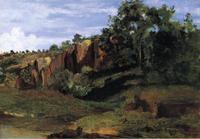
Two Italians, an Old Man and a Young Boy
Camille Corot
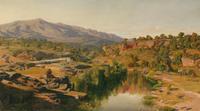
A Country, Surroundings Of Azañon
Martín Rico y Ortega
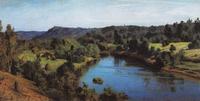
The River Oyat
Vasily Polenov
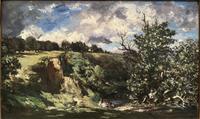
Bird-nesting
Philip Wilson Steer

Mountainous Landscape
Camille Corot
Aragvi
Pyotr Konchalovsky
Olevano, La Serpentara
Camille Corot
Valley of the Creuse, Sunset
Claude Monet
Barranca del Agua Santa
Jose Maria Velasco
The purple noon’s transparent might
Arthur Streeton
Montagne Sainte-Victoire from Lauves
Paul Cezanne
Panoramic landscape
Theodore Rousseau