Expert analysis of Camille Corot’s Portrait of Octavie Sennegon
Style: Realism · Genre: portrait
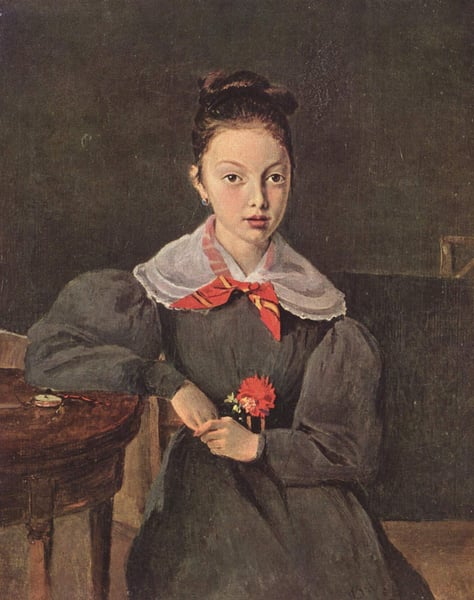
Expert Art Historical Analysis: "Portrait of Octavie Sennegon" (1833) by Jean-Baptiste-Camille Corot
This intimate portrait of the artist’s young niece exemplify Corot’s place within the Realist movement while also revealing his unique blend of classical restraint and natural observation. Though Corot is celebrated as the father of the Barbizon school and a precursor to Impressionism for his luminous landscapes, his portraits—particularly this one—demonstrate how Realism’s core tenet of truth-to-life could be achieved through simplicity and psychological depth rather than dramatic narrative.
What makes it significant within Realism and its period:
-
A Quiet Revolution in Portraiture
Unlike the grand, idealized portraits typical of Neoclassicism or the theatrical expressions of Romanticism, Corot depicts Octavie Sennegon with remarkable directness. She is shown in three-quarter view, wearing a modest white bonnet and dark dress, set against a plain, warm-brown background. There is no allegorical prop, no landowner’s estate, no indication of social status beyond quiet domesticity. This aligns with Realism’s rejection of artifice: the subject is ordinary, yet the painting dignifies her stillness and composure. -
Mastery of Tone and Atmosphere
Corot’s signature “silvery” palette—here a soft harmony of muted grays, umbers, and whites—creates a unified, almost monochromatic field that focuses attention entirely on the sitter’s face and hands. The light falls gently, modeling form without harsh contrast, which was a hallmark of Corot’s evolving technique. This tonal unity was radical for its time, anticipating the subdued palettes of later Realists like Jean-François Millet and even the subtle tonalism of James McNeill Whistler. -
Psychological Presence through Restraint
The painting’s significance lies in its refusal to impose emotion. Octavie’s gaze is steady but slightly averted, her expression neutral yet alert. Corot avoids the sentimentality that often marked portraits of young women. Instead, he captures a moment of pause—a Realist’s commitment to documenting what is, not what is wished. The delicate handling of her hands (one resting, one holding a red book) adds a note of tactile reality without narrative overstatement. -
Bridge Between Romanticism and Impressionism
While the composition is firmly Realist in its honesty, Corot’s soft, atmospheric edges and the graceful blurring of her cap’s lace anticipate the looser brushwork of the Impressionists. The painting is both a document of a specific person and a study in light and air, making it a pivotal work that connects the observed world of mid-century Realism to the sensory explorations of the 1870s.
Legacy:
Portrait of Octavie Sennegon is often cited as one of Corot’s most tender and accomplished portraits. It demonstrates that Realism in portraiture need not be a mere copy of nature, but can achieve profound intimacy through economy of means. The work remains a touchstone for understanding how a landscape master applied his plein-air sensitivity to the human face, reminding us that the most radical truth can be found in the quietest glance.
Visually similar
20 works with related composition and palette
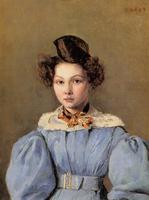
Marie Louise Sennegon
Camille Corot
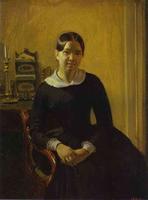
Portrait of Anna Zhdanovich
Pavel Fedotov
Dreamer
Orest Kiprensky
Portrait of an Unknown
Vasily Perov
Portrait of Ye. P. Zhdanovich
Pavel Fedotov
Alexina Ledoux
Camille Corot
Portrait of Louis Guillaume
Paul Cezanne
My Daughter Alice
William Merritt Chase
Girl by a Window
Wilhelm Leibl
Czene Béla, Bessy
Czene Béla
A Lady in Brown
William Merritt Chase
Dark Bridget Lavelle
Robert Henri
Lady in a Black Dress
Pierre-Auguste Renoir
Portrait of Artist E. Zvantseva
Konstantin Somov
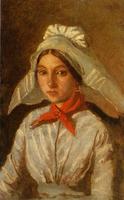
Young Girl with a Large Cap on Her Head
Camille Corot
Portrait of Jean Monet Wearing a Hat with a Pompom
Claude Monet
Young woman in the living room
Pompeo Mariani
Portrait of the Painter Kitty Kielland
Harriet Backer
Portrait of Anna Ostroumova-Lebedeva
Konstantin Somov
Portrait of S.A. Repina
Ilya Repin