Roman Countryside
Analisi esperta di Roman Countryside di Camille Corot
Stile: Realism · Genere: landscape
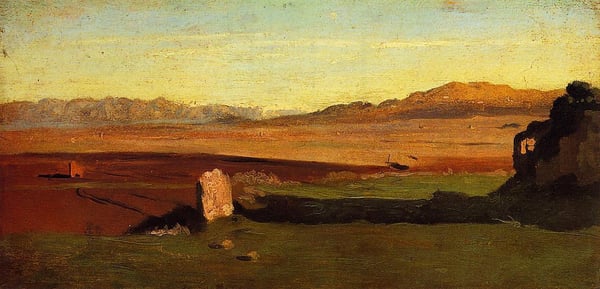
Camille Corot’s Roman Countryside is a quintessential example of Realist landscape painting, yet it also quietly anticipates the atmospheric breakthroughs of Impressionism. Within the framework of Realism—which sought to depict everyday scenes with truth and direct observation—Corot’s work is celebrated for its poetic balance between naturalism and a soft, lyrical treatment of light.
Significance within its style and period:
-
Mastery of tonal harmony and atmosphere: Unlike the dramatic, idealized landscapes of Neoclassicism or the meticulous detail of early Realism, Corot’s Roman Countryside achieves an almost meditative calm. He uses a subdued palette of silvery greens, warm earths, and muted blues, modulating tones to capture the luminous quality of the Italian light—a hallmark of his Roman studies. This approach would later influence the Barbizon School and, ultimately, the Impressionists’ focus on plein-air luminosity.
-
Blending of sketch and finished work: Corot’s landscapes often retain the freshness of an étude (a quick outdoor study) while being refined for exhibition. In Roman Countryside, the brushwork is loose and suggestive in the foliage and sky, yet the composition retains a classical stability—a bridge between the structured landscapes of the past and the more spontaneous realism of the future. This duality made his work both respected by academicians and admired by avant-garde artists.
-
Influence on Modern Landscape: Corot’s treatment of the Roman campagna—ancient ruins and modest farmhouses set against a vast, open sky—set a template for seeing the countryside as a place of quiet human presence within nature, not as a heroic or exotic setting. His ability to capture the fleeting effects of weather and time of day within a realist framework made Roman Countryside a touchstone for later artists seeking truth in atmosphere over narrative.
In short, this work is significant because it exemplifies Corot’s unique synthesis: a realist’s fidelity to nature filtered through a poet’s sensitivity to light, establishing him as a pivotal figure between the academic tradition and the modern landscape revolution.
Museum / Gallery
Visivamente simili
20 opere con composizione e palette affini
View of mountains, Auvergne
Theodore Rousseau
The Roman Campagna with the Claudian Aqueduct
Camille Corot
A Windmill at Montmartre
Camille Corot
Campagna di Roma (study for Aqueduct near Rome)
Thomas Cole
Clouds over Hills. Study
Fyodor Vasilyev
Cloud over the mountain valley
Arkhyp Kuindzhi
Peñascos del cerro de Atzacoalco
Jose Maria Velasco
Irish Landscape
Richard Jack
Tyrolean Landscape. Study for Der Sämann
Albin Egger-Lienz
Twilight
Arkhyp Kuindzhi
Am Kalvarienberg Bei Bozen
Albin Egger-Lienz
The Roman Cammagna, with the Tiber
Camille Corot
A herd of horses in Baraba steppes
Vasily Surikov
Vallata a Castiglioncello
Giuseppe Abbati
Shoreham Bay near Brighton
John Constable
Autumn Morning
Janos Tornyai
Nebraska, On the Plain
Albert Bierstadt
Mont Soracte
Camille Corot
Landscape by the Lake
Camille Corot
Gathering Clouds
Benjamin Brown