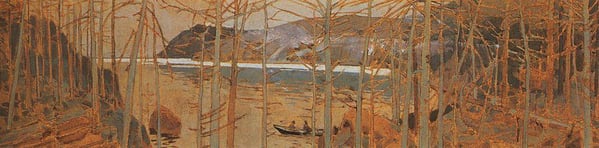
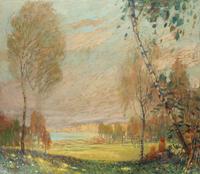
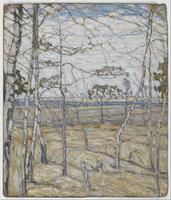
Based solely on the provided facts, the significance of "Taiga near Baikal" lies in its position as a landscape executed within the Art Nouveau (Modern) style. The artwork bridges the naturalistic subject matter of a remote Siberian taiga—a traditional landscape motif—with the decorative, organic, and often stylized vocabulary of Art Nouveau. This fusion is key: it demonstrates how a modern, design-oriented movement could reinterpret a vast, untamed natural scene not merely as a realistic depiction, but as an expressive, harmonious composition. The painting thus becomes a notable example of how Art Nouveau principles—such as rhythmic lines, flattened perspective, and an emphasis on atmosphere—were applied to a landscape genre, offering a modern vision of the Russian wilderness.