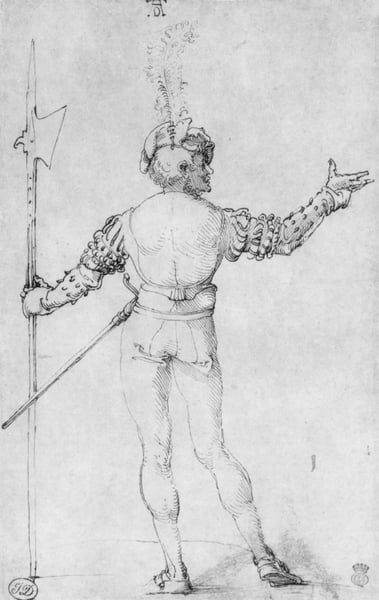
Albrecht Durer sanatçısının Back figure eseri hakkında uzman analizi
Tarz: Northern Renaissance · Tür: genre painting
"Back Figure" by Albrecht Dürer exemplifies the Northern Renaissance’s fusion of meticulous naturalism with a burgeoning interest in human anatomy—a preoccupation Dürer absorbed from Italian Renaissance ideals and then translated through his own meticulous Germanic precision. As a genre painting, the work transcends mere everyday observation; it elevates the study of the human form to a subject of intellectual and artistic inquiry. Dürer’s rendering of the back—a viewpoint often overlooked in favor of the face or front—demonstrates his mastery of contour, musculature, and the subtle play of light across the spine and shoulders. This piece is significant because it embodies Dürer’s dual role as artist and scientist: he was among the first Northern European painters to systematically apply proportion and perspective to the nude body, preparing the ground for later anatomical studies. The focus on a single, anonymous figure from behind also invites contemplation of form over identity, marking a shift toward the kind of dispassionate observation that would define both Renaissance humanism and the emerging tradition of life drawing. In the context of Dürer’s oeuvre, "Back Figure" stands as a testament to his lifelong effort to reconcile Northern Gothic detail with classical harmony—a synthesis that makes his work a cornerstone of the Northern Renaissance.
Museum / Gallery
Görsel olarak benzer
İlişkili kompozisyon ve renk paletine sahip 20 eser
Soldiers
Albrecht Durer
The banner swinger
Albrecht Durer
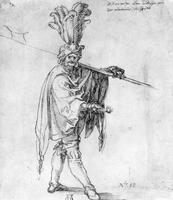
Landsknecht
Albrecht Durer
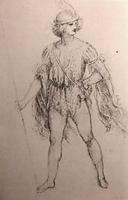
Drawing of a fancy dress costume
Leonardo da Vinci
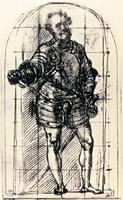
Study for the Duke of Urbino
Titian
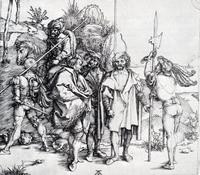
Five Lansquenets And An Oriental On Horseback
Albrecht Durer
A peasant and three bustlength figures
Hieronymus Bosch
Noble woman at horses and Lansquenet
Albrecht Durer
Sharing out the Game
Bernard Van Orley
St. Catherine and the executioner
Albrecht Durer
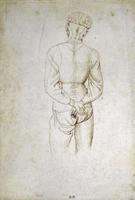
Study of a Young Man with his Hands tied behind his back
Pisanello
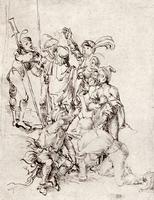
Soldiers under the cross
Albrecht Durer
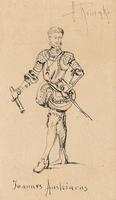
Don Juan de Austria ("Joannes Austriacus")
Anton Romako
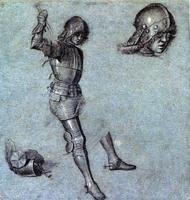
Three Studies of a Cavalier in Armor
Vittore Carpaccio
Soldier.Costume design for Gartman`s ballet
Konstantin Korovin
Jacques de Caumont
Frederick Sandys
Oliver Cromwell
Charles Turner
Fencing Reiter
Albrecht Durer
She began to think of confessing that she was a Woman
Arthur Rackham
The Art of Cooking
Carlo Urbino