
Expertenanalyse zu Albrecht Durers Noble woman at horses and Lansquenet
Stil: Northern Renaissance · Genre: portrait
Expert Analysis: "Noble woman at horses and Lansquenet" by Albrecht Dürer
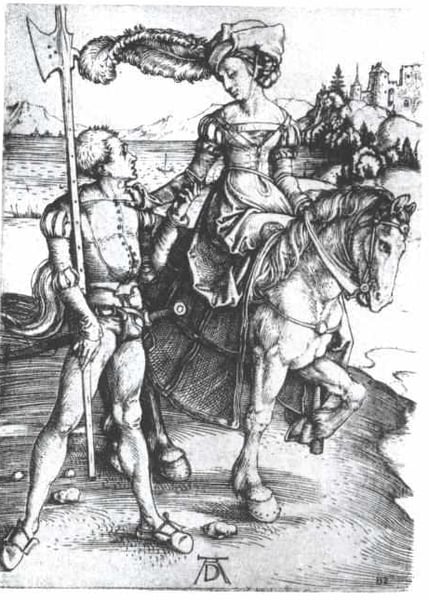
Albrecht Dürer’s Noble woman at horses and Lansquenet stands as a compelling example of Northern Renaissance portraiture, imbued with the period’s hallmark attention to meticulous detail, symbolic richness, and social commentary. While the work belongs to the portrait genre, it transcends a conventional likeness by integrating narrative elements—the horses and the lansquenet (a German mercenary soldier)—that situate the sitter within a specific social and cultural context.
Significance within the Northern Renaissance
-
Conjunction of Status and Symbolism
The noblewoman is framed not in isolation but in dynamic relation to horses (often symbols of power, nobility, and refinement) and a lansquenet (a figure emblematic of mercenary service, transience, and the martial realities of 16th-century Europe). This juxtaposition reflects the Northern Renaissance fascination with the layered meanings of everyday objects and figures. Dürer likely uses these elements to underscore the subject’s elevated rank while acknowledging the military and economic forces that supported it—a subtle nod to the interplay between aristocracy and the emerging professional soldier class. -
Precision and Naturalism
Typical of Dürer’s Northern Renaissance practice, the work displays an almost scientific observation of textures: the sheen of the horses’ coats, the crisp folds of the noblewoman’s garments, and the weathered details of the lansquenet’s attire. This realism serves both documentary and allegorical purposes, grounding the portrait in tangible reality while inviting contemplation of social hierarchies. -
Innovation in Portrait Narrative
Unlike static portraits of the era, Dürer creates a scene that implies a moment of encounter or departure. The inclusion of horses suggests movement or journey, and the presence of the lansquenet introduces a narrative tension—perhaps a guard, a messenger, or a symbolic figure of fortune’s fickleness. Such multi-figure portraiture was relatively rare and demonstrates Dürer’s ambition to elevate portraiture beyond mere likeness into a storytelling genre.
Legacy
This work exemplifies Dürer’s mastery in blending Northern Renaissance naturalism with humanist symbolism, offering a window into the complex social fabric of early modern Germany. It remains significant for its nuanced representation of gender, class, and militarism, all rendered with the exacting detail that defines Dürer’s place as a titan of the Northern Renaissance.
Visuell ähnlich
20 Werke mit ähnlicher Komposition und Farbpalette
Knight in Armor Riding toward the Right
Lucas Cranach the Elder
The Knight and the Landsknecht
Albrecht Durer
Five Lansquenets And An Oriental On Horseback
Albrecht Durer
The banner swinger
Albrecht Durer
Young Couple Threatened by Death ( Promenade)
Albrecht Durer
Soldiers
Albrecht Durer
The young peasant and his wife
Albrecht Durer
The Great Courier
Albrecht Durer
Couple on Horseback
Albrecht Durer
The Conversion Of St. Paul
Albrecht Durer
The St. George killing the dragon art
Albrecht Altdorfer
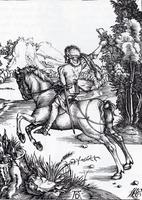
The Small Courier
Albrecht Durer
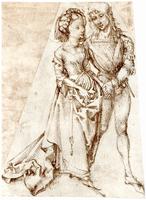
Young couple
Albrecht Durer
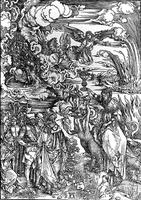
The Whore of Baylon
Albrecht Durer
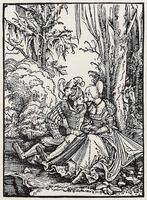
Lovers
Albrecht Altdorfer
Don Quixote
Gustave Dore
Samson and Delila
Lucas van Leyden
Don Quixote
Gustave Dore
Fencing Reiter
Albrecht Durer
Oliver Cromwell
Charles Turner