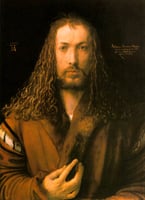
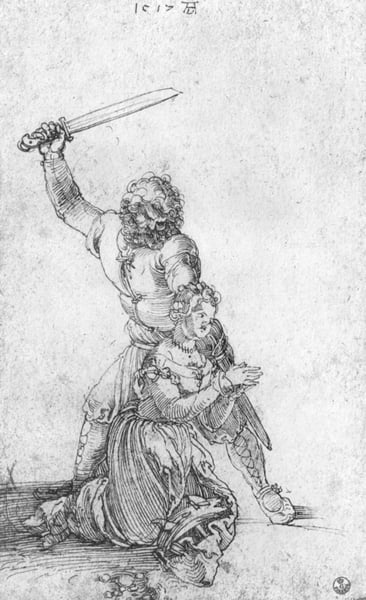
Analisi esperta di St. Catherine and the executioner di Albrecht Durer
Stile: Northern Renaissance · Genere: religious painting
This artwork by Albrecht Dürer, St. Catherine and the Executioner, is a significant example of Northern Renaissance religious painting. Despite its relatively small factual footprint, the work can be analyzed through the lens of Dürer’s pivotal role in the Northern Renaissance.
Significance within the Northern Renaissance:
-
Synthesis of Northern Precision and Italian Humanism: Dürer was the first Northern European artist to fully absorb the principles of the Italian Renaissance (perspective, classical proportion, idealized anatomy) while retaining the meticulous detail, rich symbolism, and emotional intensity characteristic of Northern art. In this painting, the executioner’s muscular, almost sculptural form reflects Dürer’s study of Italian models, while the saint’s delicate features, luxurious fabrics, and the crisp rendering of her attributes—likely the broken wheel and sword—demonstrate the Northern passion for naturalistic precision and symbolic clarity.
-
Psychological Depth and Narrative Tension: The moment depicted—St. Catherine awaiting her martyrdom—is charged with Dürer’s signature humanist empathy. Unlike earlier, more static depictions of saints, Dürer captures a psychological exchange: the executioner’s grim resolve contrasts with Catherine’s serene acceptance, a calm rooted in faith. This interiority, expressed through subtle gestures and gazes, was revolutionary for its time and aligns with the Northern Renaissance focus on individual piety and emotional realism.
-
Technical Mastery and Printmaking Legacy: Although this is a painting, Dürer’s background as a master printmaker (especially of woodcuts and engravings) informs his handling of line and texture. The precise cross-hatching in the drapery, the modeling of flesh tones through delicate glazes, and the intricate rendering of the executioner’s armor all point to an artist who treated the painted surface with the rigor of a print. This cross-medium discipline was a hallmark of Dürer’s influence, elevating the status of Northern painting through its graphic clarity.
-
Iconography of Female Sanctity: St. Catherine of Alexandria was a popular saint in the Northern Renaissance, emblematic of learning and intellectual faith (she debated pagan philosophers). Dürer’s portrayal emphasizes her as both a refined, aristocratic figure and a martyr of unshakeable conviction. The juxtaposition of her passive, contemplative stance with the active violence of the executioner encapsulates the Northern preoccupation with the tension between earthly suffering and divine grace.
In summary, St. Catherine and the Executioner is significant as a microcosm of Dürer’s genius: a work that marries the loving detail of Northern Gothic tradition with the structural and humanist ideals of the Italian Renaissance, all while pushing the boundaries of narrative, emotion, and technical finish that defined the Northern Renaissance at its peak.
Museum / Gallery
Visivamente simili
20 opere con composizione e palette affini
Jael Killing Sisera, Ornamental Frame
Lucas van Leyden
Soldiers Conversing
Salvator Rosa
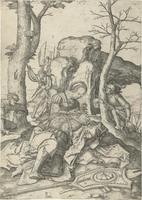
Samson and Delila
Lucas van Leyden
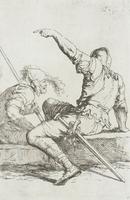
Two Soldiers Seated, Conversing
Salvator Rosa
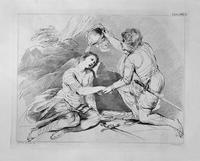
Baptism of Clorinda, by Guercino
Giovanni Battista Piranesi
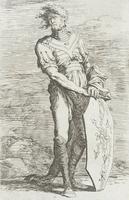
Standing Warror with Shield
Salvator Rosa
Soldiers under the cross
Albrecht Durer
The Mocking of Christ
Albrecht Durer
Crucifixion of Apostle Matthew, AD 70
Jan Luyken
Apostle James Beheaded, AD 45
Jan Luyken
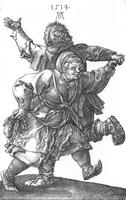
Peasant Couple Dancing
Albrecht Durer
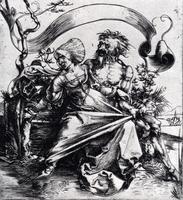
Young Woman Attacked By Death
Albrecht Durer
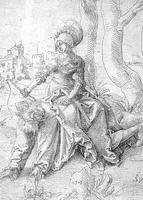
Aristotle and Phyllis
Hans Baldung
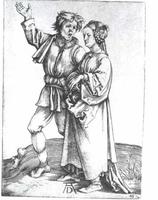
The young peasant and his wife
Albrecht Durer
Three Soldiers
Salvator Rosa
Diogenes and Alexander
Salvator Rosa
Martyrdom of Felicitas of Tuburbia in Mauretania, AD 201
Jan Luyken
a Warrior
Salvator Rosa
Christ Taken Captive
Albrecht Durer
Arrest of Christ
Albrecht Durer