
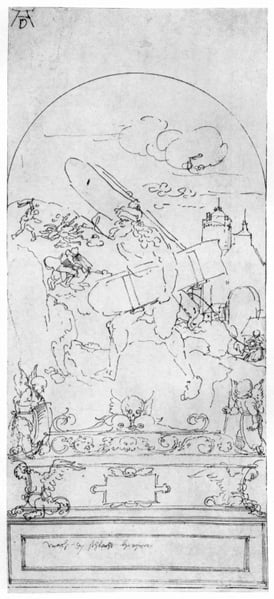
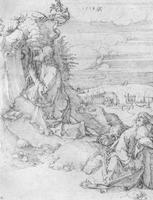
Design for the Fugger Chapel in Augsburg Simson with the doors of Gaza
Expertenanalyse zu Albrecht Durers Design for the Fugger Chapel in Augsburg Simson with the doors of Gaza
Stil: Northern Renaissance · Genre: design
This drawing, Design for the Fugger Chapel in Augsburg: Samson with the Doors of Gaza by Albrecht Dürer, is a masterwork of the Northern Renaissance that exemplifies the period’s shift from purely devotional imagery toward classicizing humanism, while retaining the meticulous detail typical of Northern art. Its significance lies in three key areas: its role as a preparatory design for a major architectural and sculptural commission, its synthesis of Northern realism with Italianate monumentality, and its bold reimagining of a biblical subject as a symbol of physical and spiritual strength.
Stylistic and Historical Context Dürer was the first Northern artist to fully absorb the principles of the Italian Renaissance—particularly proportion, perspective, and the classical nude—and then translate them into a distinctly Northern idiom. This drawing was created as a design for the Fugger Chapel in Augsburg, a prestigious family chapel funded by the immensely wealthy Fugger banking dynasty. The Fuggers, like many Northern patrons, competed with Italian courts in their lavish artistic projects, and Dürer’s design reflects that ambition.
Subject and Composition The scene depicts the Old Testament hero Samson tearing the gates of Gaza from their hinges and carrying them away (Judges 16:1-3). Dürer portrays Samson in a dramatic, contrapposto stance, his muscular body rendered with anatomical precision that echoes classical sculpture—a clear departure from the flat, symbolic figures of the Gothic tradition. Yet the detailed rendering of the city walls, the heavy wooden doors, and the densely hatched texture of the drawing is unmistakably Northern. This fusion of sculptural form and graphic intricacy makes the design a landmark in the history of drawing as an autonomous art form.
Significance
-
Renaissance Unity of the Arts: The piece is a design for an integrated chapel program—part architecture, part sculpture, part painting. Dürer’s ability to conceive a powerful sculptural figure in two dimensions demonstrates his role as a total artist, bridging the crafts in the Renaissance manner.
-
Humanist Allegory: Samson was a popular Renaissance type for virtus (strength/virtue) often allegorized as Christ’s victory over sin or, in a patron context, the Fugger family’s triumph in commerce and faith. Dürer gives the figure a heroic, almost Michelangelesque energy, placing him at the vanguard of the Northern adoption of the heroic nude.
-
Technical Mastery: The drawing’s confident pen-and-ink line, varied hatching for volume and shadow, and careful balancing of negative space show Dürer at the height of his graphic powers. It is both an instrument for a specific commission and an independent work of art—a hallmark of the Northern Renaissance fascination with the artist’s hand and intellect.
In sum, this design encapsulates the Northern Renaissance’s transition from late-medieval craftsmanship to inventive, humanistic art, and it stands as a testament to how Dürer’s synthesis of German detail and Italian grandeur redefined the possibilities of preparatory drawing.
Visuell ähnlich
20 Werke mit ähnlicher Komposition und Farbpalette
Studies of Monsters
Hieronymus Bosch
Moorish battle two
Hieronymus Bosch
The Theatre Gaillard
Felicien Rops
Le triomphe de Bacchus
Jacopo Bellini
Illustration to the Iliad
John Flaxman
Study for 'The Knight's Dream'
Raphael
Allegorie on the battle of Șelimbăr
Hans von Aachen
Studies for Four Figures
Palma il Giovane
Karikatur Auf Den Oberaufseher Leutnant Johann Nieß
Joseph Anton Koch
Study sheet with the Rape of Europa
Albrecht Durer
St Michael Fighting the Dragon
Albrecht Durer
Anacreon's Grave
Orest Kiprensky
Allegory on Social Injustice
Albrecht Durer
Rest on the Flight
Albrecht Durer
The fight of good spirits against evil spirits
Vasily Surikov
Venus in her chariot
Giovanni Battista Piranesi
The Whore of Baylon
Albrecht Durer
Apollo and the Muses on Parnassus
Hans Holbein the Younger
Illustration to the Iliad
John Flaxman
Christ on the Mount of Olives
Albrecht Durer