
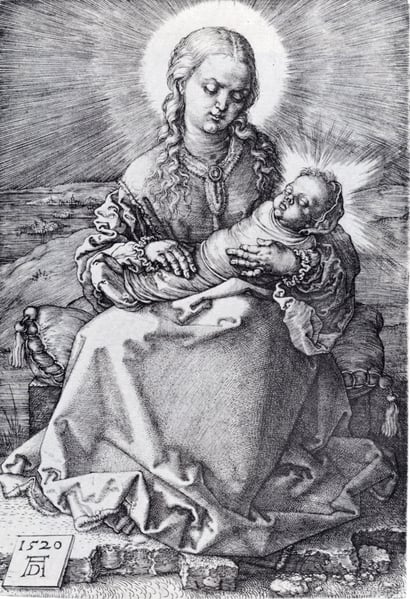
Albrecht Durer sanatçısının Madonna With The Swaddled Infant eseri hakkında uzman analizi
Tarz: Northern Renaissance · Tür: religious painting
Expert Art Historical Analysis: "Madonna With The Swaddled Infant" by Albrecht Dürer
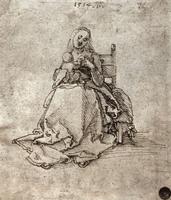
Albrecht Dürer’s Madonna With The Swaddled Infant is a quintessential example of the Northern Renaissance’s fusion of meticulous naturalism with profound religious symbolism. As a religious painting, it transforms a traditional devotional subject into an intimate, human-centered scene, reflecting the period’s shift toward observing the tangible world while retaining spiritual significance.
Significance within the Northern Renaissance style:
Dürer elevates the everyday detail of swaddling—a common practice in 15th- and 16th-century Germany—into a powerful theological statement. The tightly wrapped infant Christ underscores His vulnerability and humanity, a central concern of Northern Renaissance piety that emphasized Christ’s incarnation and suffering. The artist’s virtuosic rendering of fabric folds, soft light, and tactile textures demonstrates the Northern obsession with surface realism, yet every element serves a devotional purpose. Unlike the idealized Madonnas of the Italian Renaissance, Dürer’s Madonna is a recognizably contemporary mother, her expression gentle yet solemn, grounding the divine in domestic experience.
Genre and period context:
This work situates Dürer at the vanguard of Northern European printmaking and painting, where he synthesized local Gothic traditions with the humanistic values he encountered in Italy. The swaddled Christ child, a motif Dürer explored in multiple engravings and drawings, becomes a meditation on the paradox of the Creator wrapped in cloth. The painting’s intimate scale and focus on mother and child align with the Northern Renaissance trend of private devotional images, intended for personal contemplation rather than public altarpieces.
Conclusion:
Madonna With The Swaddled Infant is significant for embodying the Northern Renaissance’s core achievement: rendering the sacred through the acutely observed, physical world. Dürer’s careful attention to the baby’s swaddling bands and the Madonna’s serene, unidealized face makes the incarnation feel immediate and real, inviting the viewer to recognize holiness in the ordinary. This work stands as a testament to Dürer’s ability to merge technical mastery with deep theological insight, a hallmark of his enduring influence on Northern Renaissance art.
Museum / Gallery
Görsel olarak benzer
İlişkili kompozisyon ve renk paletine sahip 20 eser
Madonna Crowned By An Angel
Albrecht Durer
Madonna Nursing
Albrecht Durer
Study sheet with Mary and Child
Albrecht Durer
Madonna and child on the grassy bank
Albrecht Durer
The holy family
Rembrandt
Madonna on the Turf Bench
Martin Schongauer
Madonna On A Grassy Bench
Albrecht Durer
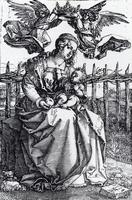
Madonna Crowned By Two Angels
Albrecht Durer
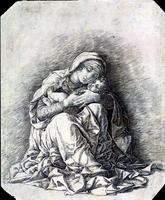
Virgin and Child (Madonna of Humility)
Andrea Mantegna
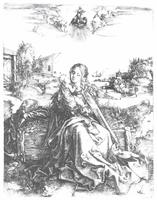
The holy family with the dragon fly
Albrecht Durer
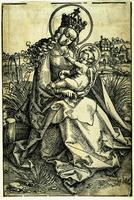
Madonna and Child
Hans Baldung
Madonna and Child in the Clouds
Rembrandt
Madonna and Child on a Stone Bench
Albrecht Durer
Mary with child wound on the grassy bank
Albrecht Durer
Mary with a pear
Albrecht Durer
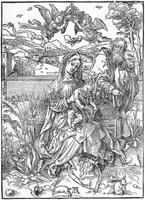
Holy Family with three Hares
Albrecht Durer
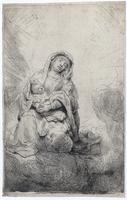
Virgin and child in the clouds
Rembrandt
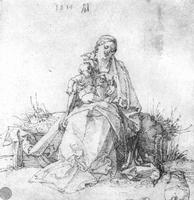
Madonna and child on the grassy bank
Albrecht Durer
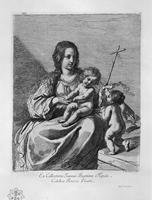
The Madonna with Child and St. John the Baptist
Giovanni Battista Piranesi
Madonna with the apple
Albrecht Durer