Martin Schongauer sanatçısının Madonna on the Turf Bench eseri hakkında uzman analizi
Tarz: Northern Renaissance · Tür: religious painting
Expert Analysis of Madonna on the Turf Bench by Martin Schongauer
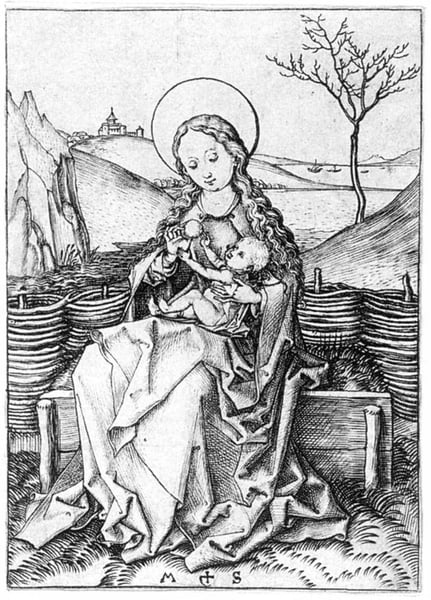
Martin Schongauer’s Madonna on the Turf Bench (c. 1470–1480) is a masterwork of the Northern Renaissance, exemplifying the period’s intense naturalism, symbolic detail, and technical brilliance. Created as an engraving—a medium in which Schongauer was the preeminent German artist of his generation—this piece demonstrates his extraordinary ability to translate painterly softness into the strict linear language of printmaking.
Key Features of Significance:
-
Naturalism and Intimacy: The Virgin is seated on a low “turf bench”—a grassy earth bank dotted with small flowers. This motif, common in German and Netherlandish art, roots the sacred scene in the everyday landscape, inviting contemplation. The tender interaction between Mary and the Christ Child, who reaches toward her, subverts formal hieratic distance in favor of human emotion. Schongauer renders folds of drapery, strands of hair, and the delicate leaves with an almost botanical accuracy, reflecting the Northern Renaissance’s devotion to observed detail as a path to the divine.
-
Technical Virtuosity in Engraving: Schongauer was the first major artist to fully exploit the expressive potential of the burin (engraving tool). Here, he achieves subtle tonal gradations through dense, parallel hatching and cross-hatching, creating volume and a soft, atmospheric light. The fine lines of the halos and the texture of the turf bench display an unparalleled control that influenced later printmakers, including the young Albrecht Dürer.
-
Symbolism and Devotional Function: The turf bench itself is laden with meaning. The grass and flowers—typically including identified species like strawberry (symbol of righteousness) and violet (humility)—allude to the hortus conclusus (enclosed garden), a symbol of Mary’s virginity and the paradise of the soul. Schongauer transforms a simple engraving into a layered devotional object, inviting the viewer to meditate on the Incarnation through the lens of nature.
-
Influence and Legacy: Madonna on the Turf Bench is a cornerstone of early print culture. It circulated widely across Europe, disseminating Schongauer’s graceful style and compositional innovations. The work bridges the late Gothic tradition of fine goldsmith-like detail with the burgeoning Renaissance interest in perspective, naturalistic anatomy, and emotional resonance.
In summary, this engraving is significant not only as a technical tour de force of the Northern Renaissance but also as a deeply moving image that fuses sacred symbolism with the tangible beauty of the natural world, securing Martin Schongauer’s reputation as a pivotal figure in the history of printmaking and religious art.
Museum / Gallery
Görsel olarak benzer
İlişkili kompozisyon ve renk paletine sahip 20 eser
Madonna and Child
Hans Baldung
Madonna By The Tree
Albrecht Durer
Madonna Crowned By Two Angels
Albrecht Durer
The holy family with the dragon fly
Albrecht Durer
Holy Family with three Hares
Albrecht Durer
Madonna With The Monkey
Albrecht Durer
Madonna On A Grassy Bench
Albrecht Durer
Madonna Crowned By An Angel
Albrecht Durer
Madonna and Child in the Courtyard
Martin Schongauer
Virgin with the Blessing Child
Rogier van der Weyden
Mary at the gate
Albrecht Durer
Holy Family
Albrecht Durer
Madonna Nursing
Albrecht Durer
The Holy Family With St. John, The Magdalen And Nicodemus
Albrecht Durer
Madonna and Child with John the Baptist
Albrecht Durer
The Holy Family with Saint Anne and Saint Joachim Gravure sur bois vers realisee 1510 1511 (Allemagne) 5 lapins se trouvent aux pieds de la Sai.jpg
Hans Baldung
Study sheet with Mary and Child
Albrecht Durer
Virgin and Child
Matthias Grünewald
Madonna With The Swaddled Infant
Albrecht Durer
Mary with child wound on the grassy bank
Albrecht Durer