
Description
Style: Northern Renaissance · Genre: allegorical painting
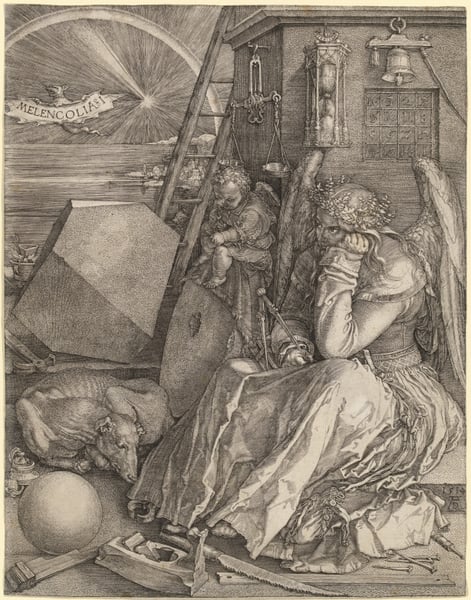
Dürer's Melencolia I is one of three large prints of 1513 and 1514 known as his Meisterstiche (master engravings). The other two are [url=https://www.wikiart.org/en/albrecht-durer/the-knight-death-and-the-devil-1513]Knight, Death, and the Devil[/url] and [url=https://www.wikiart.org/en/albrecht-durer/st-jerome-in-his-study-1514]Saint Jerome in His Study[/url]. The three are in no way a series, but they do correspond to the three kinds of virtue in medieval scholasticism--moral, theological, and intellectual--and they embody the complexity of Dürer's thought and that of his age. Melencolia I is a depiction of the intellectual situation of the artist and is thus, by extension, a spiritual self-portrait of Dürer. In medieval philosophy each individual was thought to be dominated by one of the four humors; melancholy, associated with glack gall, was the least desirable of the four, and melancholics were considered the most likely to succumb to insanity. Renaissance thought, however, also linked melancholy with creative genius; thus, at the same time that this idea changed the status of this humor, it made the self-conscious artist aware that his gift came with terrible risks. The winged personification of Melancholy, seated dejectedly with her head reasting on her hand, holds a caliper and is surrounded by other tools associated with geometry, the one of the seven liberal arts that underlies artistic creation--and the one through which Dürer, probably more than most artists, hoped to approach perfection in his own work. An influential treatise, the De Occulta Philosophia of Cornelius Agrippa of Nettesheim, almost certainly known to Dürer, probably holds the explanation for the number I in the title: creativity in the arts was the realm of the imagination, considered the first and lowest in the hierarchy of the three categories of genius. The next was the realm of reason, and the highest the realm of spirit. It is ironic that this image of the artist paralyzed and powerless exemplifies Dürer's own artistic power at its superlative height.
Museum / Gallery
Visually similar
20 works with related composition and palette
The Virgin Worshipped by Angels and Saints
Albrecht Durer
Christ on the Mount of Olives
Albrecht Durer
A Life of the Virgin
Albrecht Durer
The idolatry of Solomon
Lucas van Leyden
Harrowing Of Hell
Albrecht Durer
Until Her Death
Frederick Sandys
Democritus in Meditation
Salvator Rosa
Salome with the Head of John the Baptist
Lucas van Leyden
Putti Testing a Mans Perception of Depth
Peter Paul Rubens
Early life of Christ in the Bowyer Bible print 9 of 21. dream of Saint Joseph
Jacques Stella
Christ on the Mount of Olives
Albrecht Durer
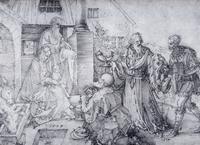
The Adoration Of The Wise Men
Albrecht Durer
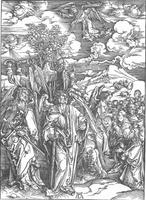
Four Angels Staying the Winds and Signing the Chosen
Albrecht Durer
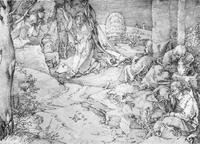
Christ on the Mount of Olives
Albrecht Durer
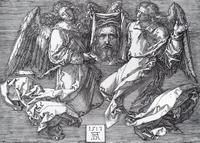
Sudarium Displayed By Two Angels
Albrecht Durer
Holy Family, crowned by two angels
Albrecht Durer
Rosamund, Queen of the Lombards
Frederick Sandys
Samson and Delila
Lucas van Leyden
Christ Appears to His Mother
Albrecht Durer
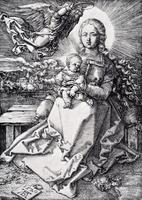
Madonna Crowned By An Angel
Albrecht Durer