Expert analysis of Albrecht Durer’s Portrait of Jacob Muffel
Style: Northern Renaissance · Genre: portrait
Expert Analysis: Portrait of Jacob Muffel by Albrecht Dürer
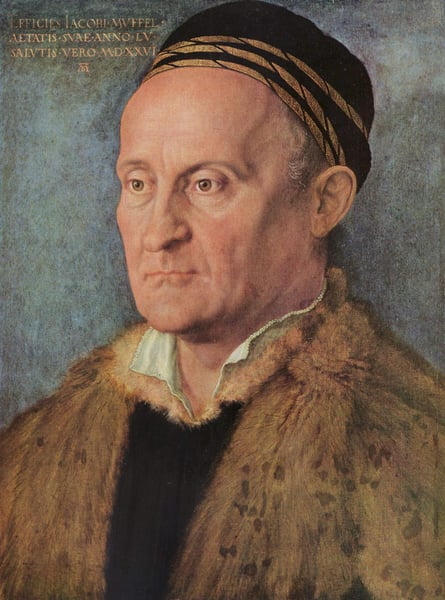
As a masterwork of the Northern Renaissance, Dürer’s portrait of Jacob Muffel—a prominent Nuremberg merchant and patrician—exemplifies the period’s revolutionary synthesis of meticulous naturalism, psychological depth, and humanist individuality. Painted in 1526, this work stands as a testament to Dürer’s unparalleled ability to combine the luminous detail of Northern European oil painting with the compositional harmony and monumentality borrowed from Italian Renaissance portraiture.
Significance within the Northern Renaissance style:
-
Technical virtuosity: Dürer renders every texture—from the sitter’s fur-collar coat to the fine wrinkles around his eyes—with an almost microscopic precision. The translucent glazes and careful handling of light on skin and fabric evoke a tangible, almost sculptural presence, characteristic of the Northern Renaissance’s devotion to observed reality.
-
Psychological presence: Unlike earlier, more formulaic profiles, this three-quarter view portrait captures Muffel’s distinct personality. His steady, direct gaze and slight, knowing smile convey intelligence, self-assurance, and the emerging ideal of the Renaissance individual—a person defined by character and civic achievement rather than merely by status.
-
Humanist iconography: The portrait functions as both a private commemoration and a public statement. Dürer, himself a humanist and friend of thinkers like Erasmus, subtly aligns Muffel with the values of learning and moral integrity. The dark background isolates the sitter, focusing attention on his face—the “window to the soul”—and reinforces the humanist belief in the dignity and uniqueness of each person.
-
Historical context: Painted during Dürer’s later career, after his transformative trips to Italy, this work shows the full maturation of his style. It bridges the Gothic heritage of Northern Europe with the classical ideals of the South, making it a key example of how German portraiture evolved into a vehicle for both realism and inner life.
In summary, Portrait of Jacob Muffel is significant not only for its breathtaking execution but also for how it crystallizes the Northern Renaissance’s core achievements: the celebration of individual identity, the marriage of art and science in representation, and the elevation of portraiture from mere record to profound human document.
Museum / Gallery
Visually similar
20 works with related composition and palette
Portrait of Nuremberger Painter Michael Wolgemut
Albrecht Durer
Portrait of a Man
Albrecht Durer
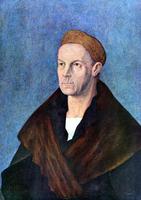
Portrait of Jakob Fugger
Albrecht Durer
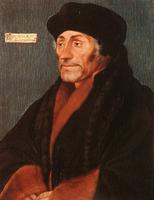
Erasmus of Rotterdam
Hans Holbein the Younger
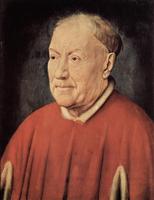
Portrait of Cardinal Albergati
Jan van Eyck
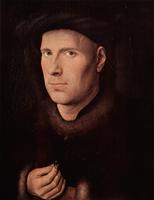
Portrait of Jan de Leeuw
Jan van Eyck
Portrait of an Old Man
Hans Holbein the Younger
Portrait of a Man
Albrecht Durer
Self-portrait
Titian
Portrait of a Man (Man in a Turban)
Jan van Eyck
Edward, Prince of Wales
Hans Holbein the Younger
Portrait of Reinerus Frisius Gemma
Maerten van Heemskerck
George Nevill, 3rd Baron Bergavenny
Hans Holbein the Younger
Portrait of a Man
Hans Holbein the Elder
Katharina Luther
Lucas Cranach the Elder
Portrait of Baudouin de Lannoy
Jan van Eyck
Portrait of Francesco da Castiglione
Jacopo Pontormo
Portrait of Desiderius Erasmus
Hans Holbein the Younger
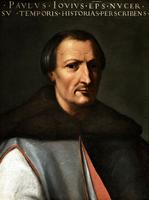
Portrait of Paolo Giovio
Cristofano dell'Altissimo
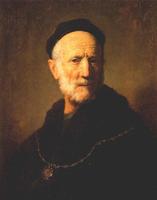
Bust of an Old Man
Rembrandt