
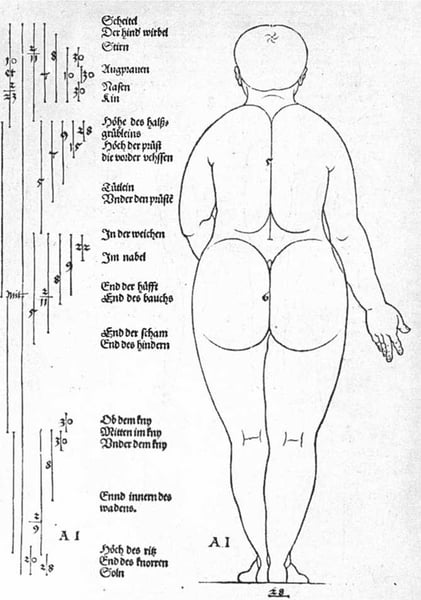
Rear view of the female
Dettagli
Analisi esperta di Rear view of the female di Albrecht Durer
Stile: Northern Renaissance · Genere: sketch and study
Expert Analysis: "Rear View of the Female" by Albrecht Dürer
Style: Northern Renaissance
Genre: Sketch and Study
Albrecht Dürer’s Rear View of the Female stands as a quintessential example of Northern Renaissance humanism filtered through meticulous empirical observation. This sketch is significant for several reasons:
-
Anatomical Precision and Renaissance Ideals: Dürer, deeply influenced by Italian Renaissance theories of proportion (particularly after his travels to Venice), applied rigorous systematic study to the human body. Here, the rear view captures the female form with a naturalistic weight and contour that breaks from the idealized, front-facing profiles typical of earlier Gothic art. The shadowing and line work convey muscular structure and skeletal support, reflecting Dürer’s belief that art must be grounded in direct observation and mathematical harmony.
-
Innovation in Draftsmanship: As a study, this work reveals Dürer’s mastery of hatching and cross-hatching to create volume on a two-dimensional surface. The subtle modulation of light across the back—from the shoulders to the sacrum—demonstrates an understanding of form that anticipates later chiaroscuro techniques. It is not merely a preparatory exercise; it is a finished statement of draftsmanship’s power to analyze and synthesize the human figure.
-
Context within Northern Renaissance Art: Unlike Italian artists who often idealized anatomy through classical sculpture, Dürer treated the body as a living, individual entity. This sketch captures a specific, unposed viewpoint—a rear perspective that was rare in art of the period—reflecting the Northern European interest in empirical reality and the unique, rather than the archetypal. It aligns with Dürer’s broader project (seen in his Four Books on Human Proportion) to codify beauty through measured observation.
-
Preparatory Function and Artistic Legacy: Sketches like this served as the foundation for Dürer’s larger, more formal works—such as his engravings and paintings of Eve or Venus. The careful study of the back’s musculature and the curve of the spine would inform his depiction of contrapposto and grace. This work thus exemplifies how the Northern Renaissance elevated the sketch from mere tool to an autonomous art form, valuing process as much as finished product.
In sum, Rear View of the Female is significant for its fusion of Northern detail and Renaissance proportion, its advanced draftsmanship, and its role in Dürer’s lifelong quest to reconcile observation with ideal beauty. It remains a testament to the artist’s ability to find profundity in the most direct of studies.
Visivamente simili
20 opere con composizione e palette affini
Studies on the Proportions of the Female Body
Albrecht Durer
Side and frontal view of the female head
Albrecht Durer
Codex Huygens Fol. 3
Carlo Urbino
Hand
Albrecht Durer
Figure of Woman Shown in Motion
Albrecht Durer
Grafe I
Constantin Flondor
Codex Huygens Fol. 33
Carlo Urbino
Female Nude
Albrecht Durer
Study on the proportions of head and eyes
Leonardo da Vinci
Male Nude (Adam)
Albrecht Durer
The Fourth 'Book of Schemes'. Album #1, the First Folder
Valerii Lamakh
L'Ecorche
Vincent van Gogh
Study of proportion
Leonardo da Vinci
The proportions of the head
Leonardo da Vinci
Nine studies of a figure
Thomas Eakins
Vrijheid
Anton Heyboer
Study of the Human Figure, Anterior View, from 'A Comparative Anatomical Exposition of the Structure of the Human Body with that of a Tiger and a Common Fowl'
George Stubbs
Frida and the Miscarriage
Frida Kahlo
The Complete Woman (Project C)
Victor Brauner
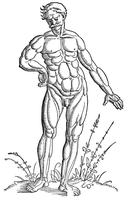
Muscle man standing
Hans Baldung