
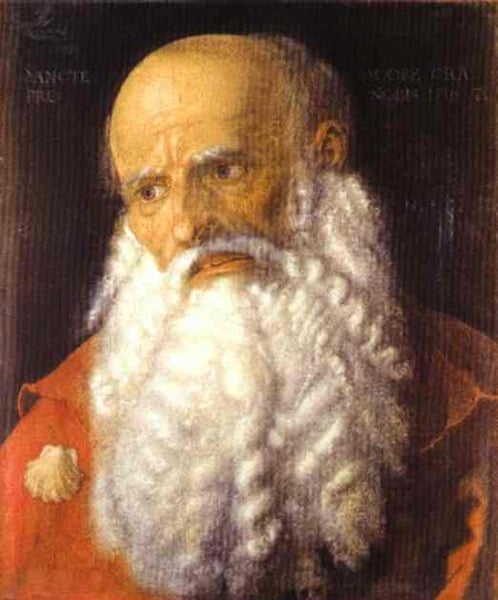
Albrecht Durer の St. James the Apostle の専門的な分析
スタイル:Northern Renaissance · ジャンル:religious painting
Expert Analysis of St. James the Apostle by Albrecht Dürer
Albrecht Dürer’s St. James the Apostle stands as a masterful example of the Northern Renaissance, a period defined by its meticulous realism, symbolic depth, and the fusion of devotional intensity with naturalistic observation. Though the work is a religious painting—depicting James the Greater, one of Christ’s closest disciples—its significance lies in how Durer elevates a familiar iconographic subject through his unparalleled technical precision and humanistic empathy.
Key Elements of Significance:
-
Integration of Northern Realism with Italian Ideals
Dürer, who traveled to Italy and absorbed the principles of perspective and proportion, brings a distinctly Northern sensibility to this apostle. The figure of St. James is rendered with extraordinary attention to texture—the subtle folds of his cloak, the weathered lines of his face, the sheen of his pilgrim’s staff. This hyper-detailed observation of material reality is a hallmark of Northern Renaissance art, yet Dürer also imbues the saint with a solid, volumetric presence that echoes Italian Renaissance sculpture. The result is a figure that feels both spiritually transcendent and palpably human. -
Symbolic and Narrative Precision
As St. James is traditionally identified by his pilgrim attributes—a staff, a scallop shell, and a hat—Dürer likely includes these with deliberate clarity. The shell, for instance, references James’s association with Santiago de Compostela, a major pilgrimage site. But beyond mere identification, Dürer uses such details to anchor the sacred in the everyday. The staff is not just an iconographic prop; its wood grain and iron band are rendered with a naturalist’s eye, suggesting the apostle’s earthly journey. This fusion of symbolic meaning and empirical accuracy was revolutionary: it allowed viewers to contemplate divine truth through the lens of tangible reality. -
Psychological Depth and Devotional Intimacy
Dürer’s St. James likely engages the viewer with a direct, contemplative gaze. In Northern Renaissance portraiture, the sitter’s inner life is often laid bare through subtle expression and lighting. Here, the saint’s face—perhaps lined by age and wisdom—conveys a quiet intensity, inviting personal meditation. This focus on individualized emotion marks a departure from the more hieratic representations of earlier medieval art. Dürer transforms a standard religious figure into a recognizable human being, making the spiritual encounter more immediate and personal for the viewer. -
Technical Virtuosity
Whether executed as a painting, engraving, or woodcut (Dürer worked across multiple media), this piece would showcase his signature linear control and tonal modulation. In print form especially, Dürer’s ability to model form with cross-hatching and delicate lines was unparalleled. The interplay of light and shadow—perhaps falling across the saint’s shoulder or highlighting the shell—creates a sculptural relief that draws the eye. Such technical mastery not only demonstrates Dürer’s skill but also serves the devotional function: the luminous clarity of the image feels like a window into a higher realm.
Conclusion:
St. James the Apostle is significant because it epitomizes the Northern Renaissance’s core achievement: the elevation of religious art through rigorous naturalism and humanistic warmth. Dürer does not simply depict a saint; he creates a vivid, approachable presence that bridges heaven and earth. The work stands as a testament to how meticulous observation and symbolic intelligence can transform a traditional subject into a timeless meditation on faith, journey, and the sacred within the ordinary.
Museum / Gallery
視覚的に類似
構図やパレットが近い作品 20 件
The Apostles Philip and James
Albrecht Durer
Apostle Philip
Albrecht Durer
Portrait of a Cardinal
Jacopo Bassano
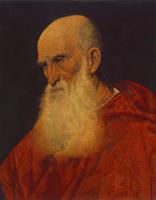
Portrait of an Old Man (Pietro Cardinal Bembo)
Titian

Old Bearded Man
Jan Lievens
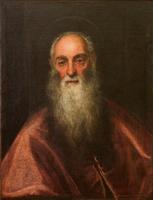
St Jerome
Tintoretto
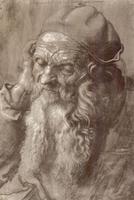
Man Aged 93 (brush & ink on paper)
Albrecht Durer
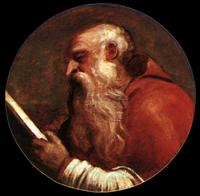
St Jerome
Titian
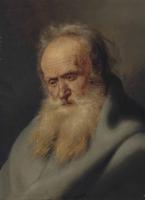
Tronie of An Old Man
Jan Lievens
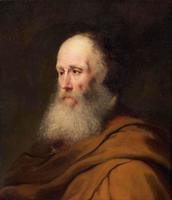
Bearded Old Man Wearing a Brown Cloak
Jan Lievens
Head of An Old Man
Thomas Stuart Smith
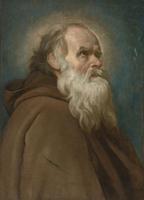
St. Anthony Abbot
Diego Velazquez
Head and Shoulders of a Bearded Man
Francesco de' Rossi (Francesco Salviati), "Cecchino"
Portrait of An Elderly Bearded Man Head and Shoulders
Tintoretto
Head of an Old Man
Jan Lievens
Portrait of a Doge
Tintoretto
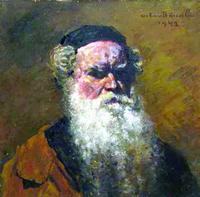
Self-Portrait (detail)
Octav Bancila
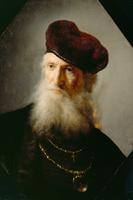
Bust of a Bearded Old Man
Rembrandt
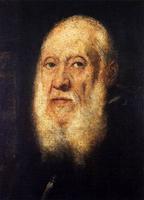
Portrait of Jacopo Sansovino
Tintoretto
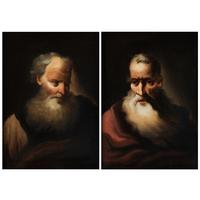
PAAR PROPHETENKÖPFE
Christian Wilhelm Ernst Dietrich