Description
Style: Northern Renaissance · Genre: religious painting
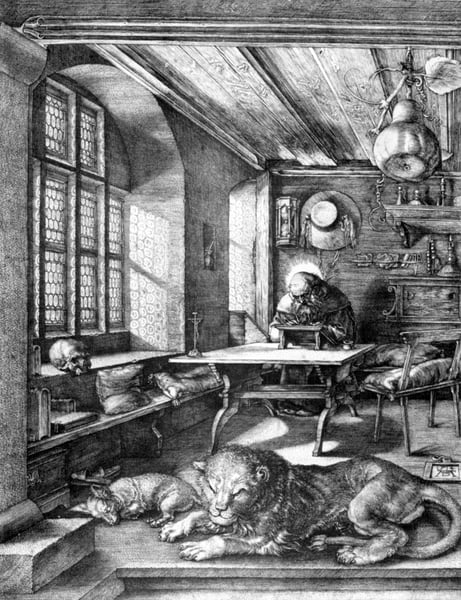
The engraving St. Jerome in his Study (1514) depicts the scholar-saint in his study in a meditative state. St. Jerome, one of four fathers of the Church, was the first to translate the Bible to Latin. Considered one of the greatest biblical scholars, St. Jerome is the patron of translators, librarians and encyclopedists. He was admired and celebrated among Renaissance humanists, including Dürer himself. In fact, Dürer featured St. Jerome more than any other saint in his work. Coincidentally, in the same year Dürer created the engraving, his friend and one of leaders of the Protestant Reformation in Nuremberg, Lazarus Spengler, published the biography of St. Jerome. In the engraving, Dürer shows an ideal state of contemplative solitude, which appeals to Renaissance humanists. The artist creates the space with perspectival accuracy, and it was even suggested that the study resembled one of the upper rooms of Dürer’s house. The engraving projects an atmosphere of intimate domesticity: the room is illuminated by a soft light, while St. Jerome works at his desk and his loyal companions, the lion and the dog, rest in the foreground. The lion is traditionally St. Jerome’s companion, referring to the story in which St. Jerome domesticated the animal, after pulling a thorn from his paw. Other details, such as the slippers under the bench and the numerous cushions, give a sense of domestic warmth and comfort.
The engraving is often analyzed together with Melencolia I (1514), another famous engraving by Dürer. Documents show that on occasion Dürer gave away the two engravings as a pair. The two engravings show two sides of the intellectual pursuit, the traditional divide of divine and secular knowledge. Thus, in the engravings, St. Jerome represents the ideal of theological wisdom juxtaposed by the frustration of the secular genius in Melencolia I. The contrast between the engravings is highlighted through composition and lighting. The space in St. Jerome in his Study is meticulous and orderly, each object has its particular place and the overall mood is serene and harmonious. On the other hand, the objects in Melencolia I are scattered in haphazard manner, which reflect the somber atmosphere. In the same way, the sunlit interior of St. Jerome’s study is opposed to the darkness that envelopes the personification of Melancholia.
One of the interesting details in the engraving is the gourd vine hanging from the threshold in the right corner of the room. In the Bible, the plant is mentioned in the Book of Jonah, where God prepared a gourd to give Jonah shade, to help relieve him from his grief. St. Jerome translated the name of the plant as hedera, a type of ivy, and rejected the old Latin translation of cucurbita, a gourd. This prompted a philological debate with St. Augustine in a letter exchange in the years 403-404. The gourd is also a symbol of transience: in the story of Jonah the gourd arose and perished in a night at God’s command. Therefore, the gourd can relate to the skull resting on the window sill, and interpreted as a memento mori, a reminder of the temporality of life. In the context of the scholarly atmosphere, the gourd hints at the philological discussion between St. Jerome and St. Augustine, and celebrates scholarly debate and theological wisdom.
Museum / Gallery
Visually similar
20 works with related composition and palette
Drinking Peasant in an Inn
Adriaen van Ostade
A family round a table with a young woman feeding her baby with her mother preparing a meal
Léon Augustin Lhermitte
Otto of the Silver Hand 7
Howard Pyle
The Family
Adriaen van Ostade
The Family
Adriaen van Ostade
The Breakfast
Adriaen van Ostade
The Peasant Settling His Debt
Adriaen van Ostade
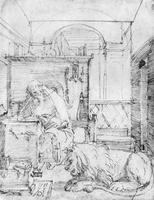
St. Jerome in His Study
Albrecht Durer
A Harlot's Progress, plate 5
William Hogarth
Reading a Tract
David Wilkie
Interior of an Inn
Adriaen van Ostade
Death and the Miser, from The Dance of Death
Hans Holbein the Younger
Interior of a peasant dwelling
David Teniers the Younger
Interior with Woman Sewing
Vincent van Gogh
The quack
Albrecht Anker
First observation of the transit of Venus by William Crabtree in 1639
Ford Madox Brown
Die Gartenlaube (the Garden Arbor)
Berthold Woltze
Interior with a woman and man
Abraham van Strij
Prayer before the Meal
Adriaen van Ostade
Welsh Interior
Thomas Stuart Smith