
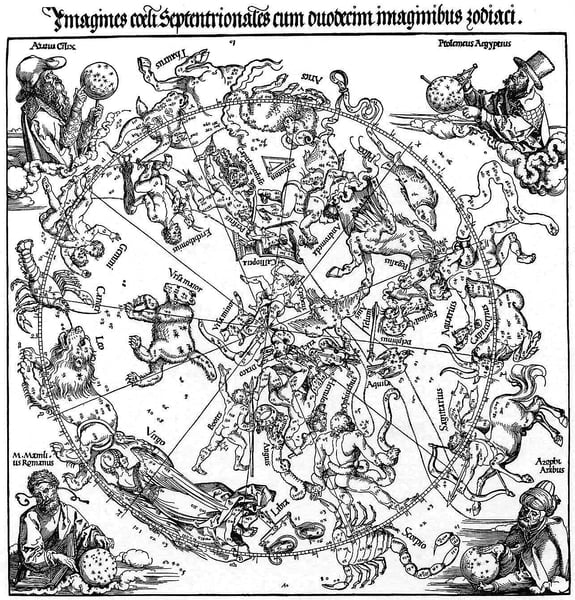
Expertenanalyse zu Albrecht Durers Star map
Stil: Northern Renaissance · Genre: design
Expert Analysis: "Star Map" (Celestial Hemispheres) by Albrecht Dürer (1515)
Style & Context:
As a pinnacle of the Northern Renaissance, Dürer’s star maps marry the era’s obsessive naturalism with its burgeoning humanist scholarship. Created as woodcuts—a medium Dürer revolutionized—these prints represent the first printed star charts of the northern and southern celestial hemispheres in Europe. They embody the Northern Renaissance fascination with empirical observation, classical revival (Ptolemy’s Almagest), and the artist’s own scientific curiosity.
Significance:
-
Scientific-Artistic Synthesis: Dürer worked with astronomers (Johannes Stabius and Konrad Heinfogel) to map 1,020 stars across 48 constellations. The maps are not merely decorative but function as accurate celestial reference tools, blending mythographic iconography with Ptolemaic coordinates. Each figure—from Orion to Cassiopeia—is rendered with the same anatomical precision Dürer applied to human subjects, yet the stars’ positions were calculated via precise projection.
-
Print Culture Milestone: As large-format woodcuts (approx. 43 cm × 43 cm each), these maps democratized astronomical knowledge. Prior to Dürer, celestial charts were hand-copied manuscripts for elites. His prints allowed for mechanical reproduction, spreading heliocentric?—no, still geocentric—cosmological understanding to scholars, navigators, and artists across Europe.
-
Aesthetic & Symbolic Power: The maps are masterworks of “design” genre, with intricate hatching and chiaroscuro that give volume to the figures. Dürer’s choice to show the constellations as classical nude figures (e.g., Hercules, the Serpent Bearer) reflects Renaissance humanism—the belief that art could harmonize religion, mythology, and science. The Northern sensitivity to texture and light is evident in the delicate rendering of star magnitudes (larger or smaller dots) and the soft shading of drapery.
-
Historical Influence: These star maps directly informed later celestial cartography (e.g., by Alessandro Piccolomini and Johann Bayer). They also inspired Dürer’s own “Melencolia I,” which includes a celestial sphere, linking mathematical order to artistic inspiration.
Conclusion:
Dürer’s star maps are not merely pretty charts; they are a manifesto of the Northern Renaissance mind—where art, science, and print technology converge. They prove that a “design” object could hold as much philosophical weight as a religious altarpiece, reshaping how Europeans envisioned the cosmos itself.
Museum / Gallery
Visuell ähnlich
20 Werke mit ähnlicher Komposition und Farbpalette
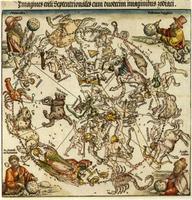
Map of the Northern Sky with representations of the constellations, decorated with (clockwise) the astronomers Aratus Cilix, Ptolemaeus Aegyptus, Azophi Arabus (Addorrhaman al Sufi) and M. Manlius Romanus, designed by the Nuremberg mathematician and astronomer Konrad Heinfogel
Albrecht Durer
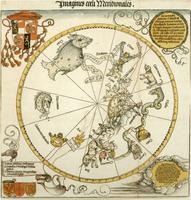
Map of the Southern Sky, with representations of constellations, decorated with the crest of Cardinal Lang von Wellenburg, and a dedication to him with his coats of arms and the Imperial copyright
Albrecht Durer
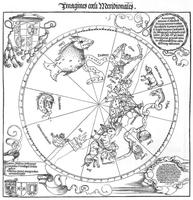
The Southern Hemisphere of the Celestial Globe
Albrecht Durer
Study sheet with horses
Leonardo da Vinci
Eight signs of the Zodiac
Giovanni Battista Piranesi
Studies of Monsters
Hieronymus Bosch
Scenes in Hell
Hieronymus Bosch
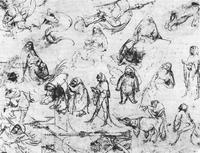
Studies
Hieronymus Bosch
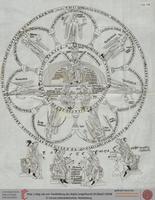
Hortus deliciarum
Herrad of Landsberg
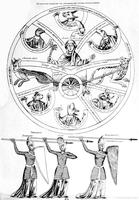
Avarice (folio 203v)
Herrad of Landsberg
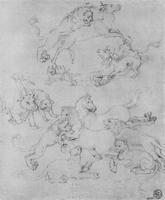
Study sheet with the attacked animals
Albrecht Durer
The Starry Sky
Konstantin Vasilyev
Hercules Killing the Molionides
Albrecht Durer
Allegory of eloquence
Albrecht Durer
Space Station (Falls Said to be the Largest in the Known World So Far)
Landon Mackenzie
The Cycle of the Seasons
Hildegard of Bingen
Two Monsters
Hieronymus Bosch
Mercy or Charity (folio 204r)
Herrad of Landsberg
Heaven
Ende
Study sheet with the Rape of Europa
Albrecht Durer