
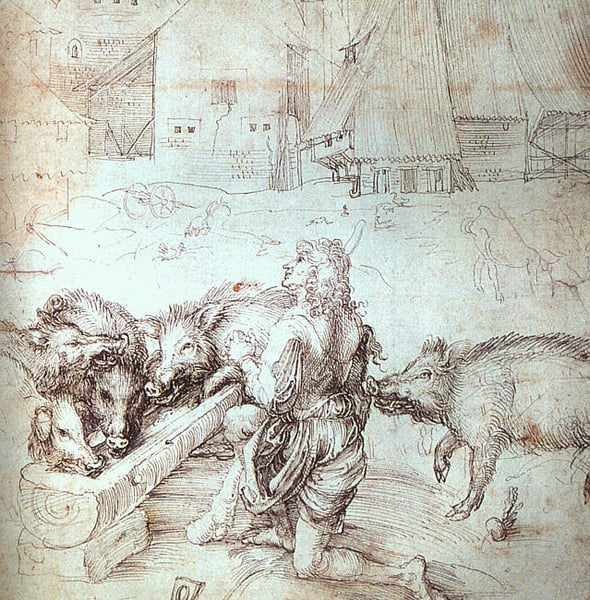
Expert analysis of Albrecht Durer’s Study for an engraving of the Prodigal Son
Style: Northern Renaissance · Genre: sketch and study
This drawing is a fascinating window into the creative process of Albrecht Dürer, the preeminent artist of the German Renaissance. As a study for an engraving, its significance lies not in a finished composition, but in the raw, investigative energy that reveals Dürer's working method and his synthesis of Northern and Italianate ideals.
The Significance of the Sketch as a Northern Renaissance Artifact: While Dürer is famous for his highly finished engravings (like the masterful Prodigal Son engraving from c. 1496 that this study likely precedes), this sketch captures the moment of intellectual and formal exploration. In the Northern Renaissance, preparatory drawings were increasingly valued as records of the artist's mind, and Dürer elevated this practice to an art form in itself.
Analysis of the Work Based on Supplied Facts:
- Style (Northern Renaissance): The sketch displays Dürer's signature precision even in an unfinished state. His linework is controlled yet searching, building volume through fine hatching. The figure of the Prodigal Son is rendered with a keen anatomical observation that bridges Northern Gothic expressiveness (the hunched, despairing posture) with Italian Renaissance attention to musculature and proportion—a hallmark of Dürer's trips to Venice.
- Genre (Sketch and Study): As a study, the work prioritizes process over polish. Dürer tests the composition: the pig-sty setting, the crumpled robes, and the anguished pose. The visible pentimenti (changes or corrections) and uncertain strokes are not flaws but valuable evidence of artistic decision-making. This is a living document of how Dürer translated a biblical parable—a favorite subject of Northern Renaissance moralizing art—into a tangible scene of penance.
Why It Matters: This study is significant because it demystifies the perfection of Dürer's prints. It shows that his famous engravings, with their meticulous cross-hatching and emotional depth, began as raw, human searches for form. The sketch embodies the Northern Renaissance tension between spiritual gravity (the Prodigal's humiliation) and worldly, empirical observation (the dirt, the swine, the textures). It is a rare record of a master thinking on paper, proving that even Dürer’s preparatory work is a masterpiece of intention and draftsmanship.
Museum / Gallery
Visually similar
20 works with related composition and palette
Monstrous Hog of Landser
Albrecht Durer
The hog
Rembrandt
4 Radierungen aus einer Folge von Tierdarstellunngen
Karel Dujardin
Don Quixote
Gustave Dore
Witch Riding Backwards On A Goat
Albrecht Durer
A Wild Boar with its Piglets Being Chased by Hounds
Paul de Vos
Men Attacking Wolves
Jean-Baptiste Oudry
Christ on the Mount of Olives
Albrecht Durer
Study sheet with the Rape of Europa
Albrecht Durer
The Satyr and the Peasant
Marcus Gheeraerts the Elder
The Adoration of the Shepherds
Carlo Urbino
Tharacus, Probus, and Adronicus Thrown to Wild Animals, AD 290
Jan Luyken
The Fall of Phaeton
Michelangelo
The Lion Dressed as King is Presented with a Bouquet of This
Wilhelm von Kaulbach
Orpheus Slain By Bacchantes, With A Boy Running Away
Albrecht Durer
Harrowing Of Hell
Albrecht Durer
Molorchos making a sacrifice to Hercules
Andrea Mantegna
Evangelist John Exiled on Patmos, AD 97
Jan Luyken
Hey! Come hither
Arthur Rackham
The Fall
Albrecht Durer