
Analisi esperta di The Fall di Albrecht Durer
Stile: Northern Renaissance · Genere: religious painting
Expert Analysis: The Fall by Albrecht Dürer (Northern Renaissance, Religious Painting)
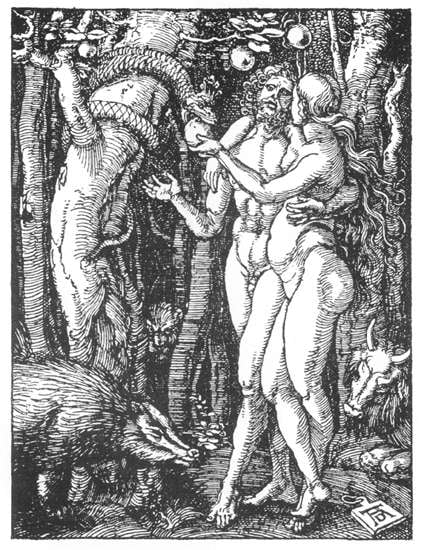
Albrecht Dürer’s The Fall (often identified with his masterful 1504 engraving Adam and Eve) stands as a pivotal work of the Northern Renaissance, merging Italianate humanist ideals with the meticulous naturalism characteristic of Northern European art. The composition depicts the biblical moment just before the Fall of Man, with Adam and Eve poised beside the Tree of Knowledge, entangled by the serpent.
Significance within the Northern Renaissance Style:
Dürer’s print exemplifies the Northern Renaissance’s obsession with empirical observation and minute detail. Every leaf, animal hide, and strand of hair is rendered with surgical precision, showcasing the artist’s unrivaled skill in engraving—a medium that allowed for the mass dissemination of complex religious imagery. The inclusion of symbolic animals (the cat, mouse, elk, and ox) draws from medieval bestiaries, but Dürer infuses them with naturalistic anatomy, reflecting the Northern interest in the observable world.
Humanist and Theological Nuance:
Unlike earlier depictions of the Fall, Dürer presents Adam and Eve as idealized, classical figures inspired by Greco-Roman sculpture and Renaissance proportion studies (notably, the influence of Vitruvian principles and Dürer’s own theoretical writings). This humanist approach elevates the pair from simple biblical characters to universal representatives of humanity’s potential and frailty. The balance of their poses—Eve reaching for the fruit while Adam nervously gestures—captures the psychological tension of temptation and impending sin.
Technical Mastery and Symbolic Density:
The engraving is a tour de force of cross-hatching and tonal control, creating a luminous, sculptural quality that rivals painting. Dürer’s signature monogram, proudly placed on a tablet, asserts the artist’s intellectual status—a radical statement for a printmaker in the early 16th century. The mountain landscape in the background, combining Northern precision with Italian atmospheric perspective, further synthesizes artistic traditions.
Legacy:
The Fall is not merely a religious illustration; it is a manifesto of Northern Renaissance ambition. Dürer successfully aligned the spiritual gravity of a sacred narrative with the revival of classical form and scientific observation, setting a new standard for printmaking and influencing generations of artists across Europe. The work’s enduring power lies in its ability to balance moral gravity with exquisite beauty—a hallmark of Dürer’s genius and the Northern Renaissance’s unique contribution to art history.
Museum / Gallery
Visivamente simili
20 opere con composizione e palette affini
Adam and Eve
Albrecht Durer
Adam and Eve
Lucas van Leyden
The Fall
Lucas van Leyden
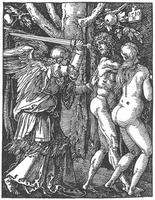
Expulsion from the Paradise
Albrecht Durer
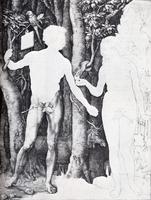
Adam And Eve
Albrecht Durer
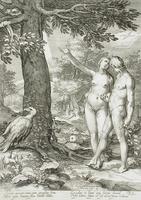
Adam and Eve Before the Tree of Knowledge
Jan Saenredam
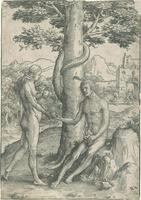
The Fall
Lucas van Leyden
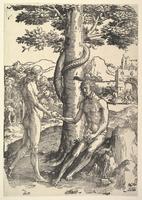
Fall of Man (Adam and Eve)
Lucas van Leyden
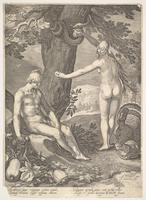
Adam and Eve
Jan Saenredam
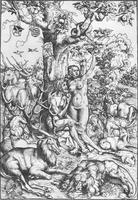
Adam and Eve in Paradise
Lucas Cranach the Elder
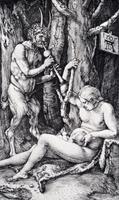
Satyr Family
Albrecht Durer
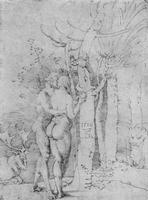
Adam and Eve
Albrecht Durer
Hercules (Effects of Jealousy)
Albrecht Durer
Aristotle and Phyllis
Hans Baldung
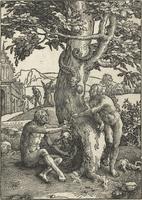
The Fall
Lucas van Leyden
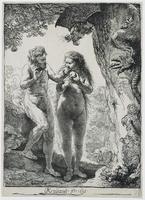
Adam and Eva
Rembrandt
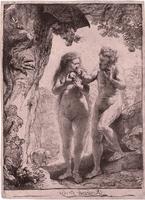
Adam and Eve
Rembrandt
Pan and Syrinx
Giovanni Battista Piranesi
Molorchos making a sacrifice to Hercules
Andrea Mantegna
Hercules and Antaeus
Andrea Mantegna