Description
Style: Northern Renaissance · Genre: allegorical painting
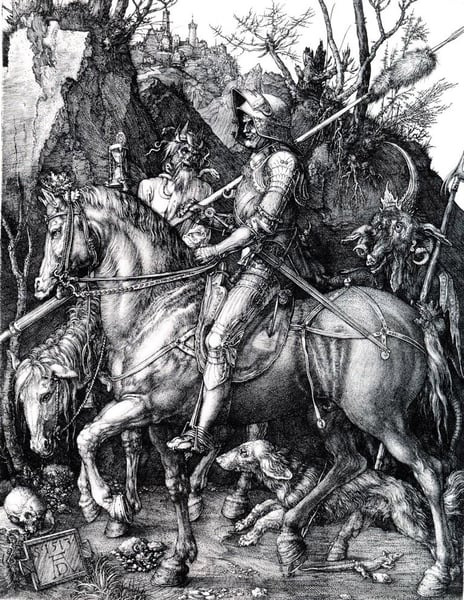
Knight, Death and the Devil (1513), is one of Dürer’s most famous and most complex artworks that has been subject to much debate among art historians. At the heart of the controversy is the figure of the knight, and his symbolic function and meaning. Frequently, Dürer’s knight was interpreted as a symbol of moral virtue, an embodiment of the ideal of the ‘Christian Knight’. Following this interpretation the knight is a stoic figure, unfazed by the devil and the monsters that try to entice him. The knight is protected by his armor, and accompanied by his dog, a symbol of loyalty. Some have tied the conception of the engraving to the Handbook of a Christian Knight, written by the Dutch humanist, Erasmus of Rotterdam. It was also suggested that the knight could have been modeled after several historical figures, including Martin Luther, Pope Julius II and Franz von Sickingen, a German knight and important figure of the early period of the Reformation.
However, more recent studies challenge the interpretation of the ‘Christian Knight’, pointing out that it overlooks the social and political context of Dürer’s time. Historical documentation refers to the phenomena of Robber Knights, who attacked and louted dealers and merchants, threatening trade and finances of cities such as Nuremberg (Dürer’s place of birth and principal place of residence). Evidence of Dürer’s contempt for these figures may exist in an earlier artwork, Death and Landsknecht (1510). In the 1510 woodcut, Death confronts the indifferent Knight, who appears unconcerned by the ominous encounter. The woodcut is accompanied by a poem written by the artist, in which he warns those who do not pay their dues in this life. If indeed the knight in Knight, Death and the Devil is a ‘Robber Knight’, the devil and death are not his adversaries, but rather his companions. In this case, the knight could be seen as passive or compliant. The contrary interpretations of the knight also impact the analysis of other details in the engraving, such as the foxtail attached to the tip of the knight’s lance. In the context of the ‘Christian Knight’ interpretation, the foxtail can be seen as a good luck charm. In contrast, according to the ‘Robber Knight’ analysis, the foxtail can symbolize the trickery and the cunning nature of the fox.
Another focal element in the engraving is the Knight’s horse, which was conceived with impressive anatomical accuracy. It is proposed that the pose of the knight and horse was inspired by Italian equestrian statues, particularly by Andrea del Verrochio’s Equestrian statue of Bartolomeo Colleoni (1480-1488), in Campo Santi Giovanni e Paolo in Venice. Because of his travels to Venice, Dürer was certainly familiar with the statue. Likewise, parallels can be made with Leonardo Da Vinci’s preparatory drawings for the equestrian monument of Francesco Sforza. Another identified source of influence is Dürer’s contemporary, German Renaissance painter, Lucas Cranach the Elder. Cranach’s woodcut, Knight in Armor Riding toward the Right (1506), demonstrates similarities in the position of the horse, the gloomy figure of the knight and the elements in the backdrop, the castle on the hill. Therefore, Dürer seems to successfully adapt a variety of sources, the robust proportions of Italian equestrian statues together with northern influences, such as Cranach’s woodcut.
Visually similar
20 works with related composition and palette
St George on Horseback
Albrecht Durer
St. George On Horseback
Albrecht Durer
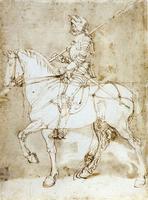
Knight on Horseback
Albrecht Durer
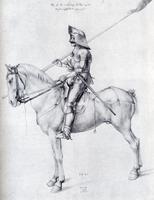
Man In Armor On Horseback
Albrecht Durer
Conquest of Tunis (Victory of Charles V)
Maerten van Heemskerck
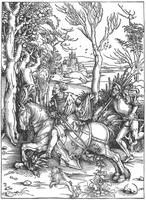
The Knight and the Landsknecht
Albrecht Durer
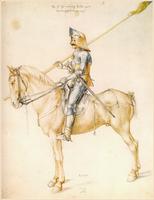
Knight On Horseback
Albrecht Durer
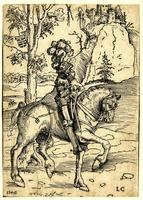
Knight in Armor Riding toward the Right
Lucas Cranach the Elder
Fencing Reiter
Albrecht Durer
Maximilian I, Holy Roman Emperor
Charles Turner
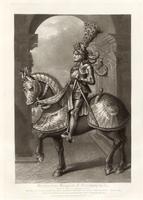
Maximilian I, Holy Roman Emperor
Charles Turner
King Arthur for the first time draws his sword Excalibur from its sheath
Arthur Rackham
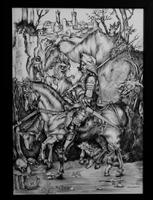
Knight, Death and the Devil
Lilian Greisse
Study for an Equestrian Portrait of the Duke of Lerma
Peter Paul Rubens
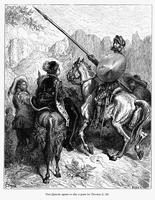
Don Quixote
Gustave Dore
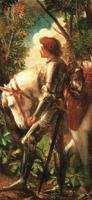
Sir Galahad
George Frederick Watts
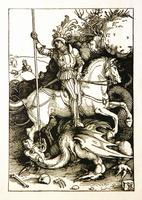
St. George and the Dragon
Albrecht Durer
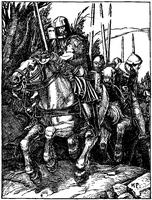
Otto of the Silver Hand 36
Howard Pyle
Philip Ii on Horseback
Peter Paul Rubens
St. George On Foot
Albrecht Durer