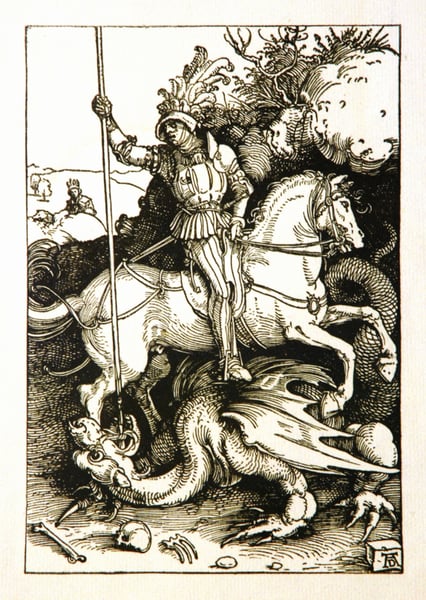
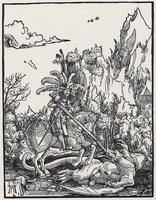
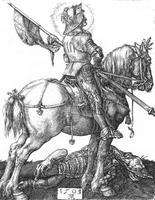
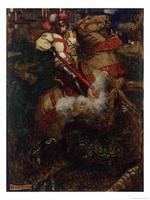
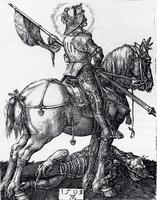
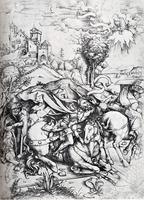
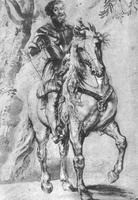
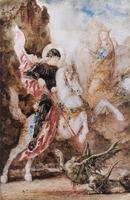
"St. George and the Dragon" by Albrecht Dürer exemplifies the Northern Renaissance’s fusion of meticulous naturalism with profound religious symbolism. As a religious painting, it depicts the iconic Christian allegory of Saint George vanquishing evil—represented by the dragon—affirming the triumph of faith and virtue. Dürer’s significance within the Northern Renaissance lies in his masterful integration of observational detail (e.g., the dragon’s scaled texture, the knight’s armor, and the landscape) with symbolic composition, reflecting the period’s emphasis on both physical realism and spiritual meaning. The work stands as a testament to Dürer’s role in bridging the ornate Gothic tradition with the emerging humanist ideals of the Renaissance, making it a pivotal example of how Northern artists combined intricate craftsmanship with narrative depth.