
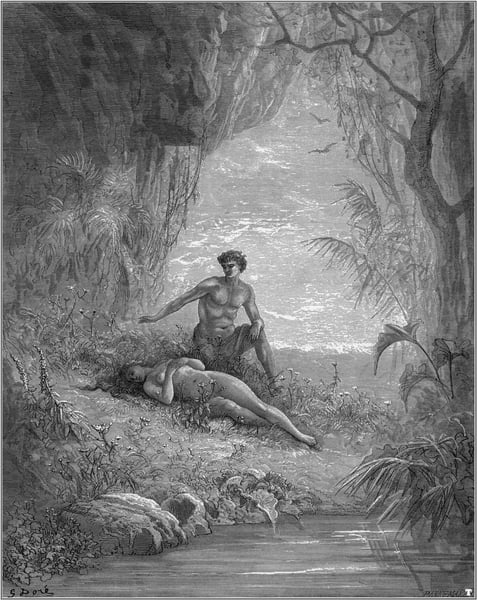
Expert analysis of Gustave Dore’s Adam and Eve
Style: Romanticism · Genre: illustration
Based solely on the provided facts—Gustave Doré's Adam and Eve, belonging to Romanticism in the genre of illustration—the artwork's significance lies in how it embodies key Romantic ideals while elevating the role of narrative imagery.
Within the Romantic style, this work would emphasize emotion, drama, and the sublime power of nature. Doré's treatment of the figures and landscape likely heightens the psychological tension of the biblical moment—the fall of humanity—focusing on individual experience and moral struggle rather than detached religious doctrine. The use of dramatic chiaroscuro (strong contrasts of light and dark) and detailed, almost theatrical composition are hallmarks of Romanticism's desire to evoke awe and introspection.
As an illustration, the piece is significant because it bridges high-art Romanticism with popular visual storytelling. Doré’s illustrations were widely disseminated through books, making dramatic, emotionally charged art accessible to a broad audience. This democratization of Romantic themes—where a print could convey the same depth of feeling as a large oil painting—marks a crucial moment in 19th-century art. The work thus stands as a testament to how illustration, often considered a “lesser” genre, could achieve the profound narrative and expressive power central to the Romantic movement.
Museum / Gallery
Visually similar
20 works with related composition and palette
The Creation of Eve
Gustave Dore
They heard, And from His presence hid themselves amoung The thickest trees
Gustave Dore
The savoury pulp they chew, and in the rind, Still as they thirsted, scoop the brimming
Gustave Dore
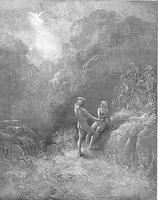
So parted they the Angel up to heaven From the thick shade, and Adam to his bower
Gustave Dore
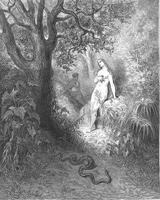
Back to the thicket slunk The guilty serpent
Gustave Dore
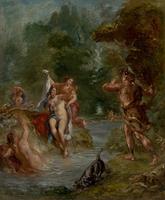
The Summer Diana Surprised by Actaeon
Eugene Delacroix
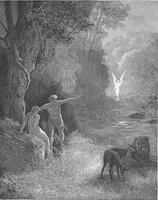
Eastward amoung those trees, what glorious shape Comes this way moving
Gustave Dore
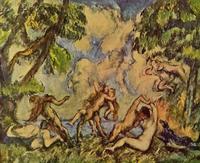
Bacchanalia. The Battle of Love
Paul Cezanne
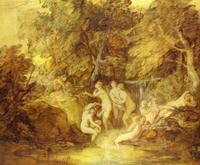
Diana and Actaeon
Thomas Gainsborough
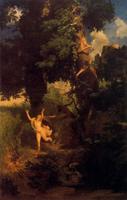
Syrinx fleeing from the onslaught of Pan
Arnold Böcklin
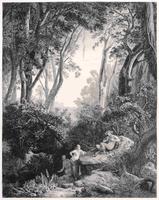
Pan und die Nymphen
Johann Wilhelm Schirmer
The Young Satyr
Stefano della Bella
Bathsheba
Taras Shevchenko
Nymph by the fountain
Arnold Böcklin
Angelica and Medor
Agostino Carracci
Apollo and Silenus
Giovanni Battista Piranesi
The Death of Ophelia
Eugene Delacroix
Water
Jan Brueghel the Elder
By the Riverbank
Hermann David Salomon Corrodi
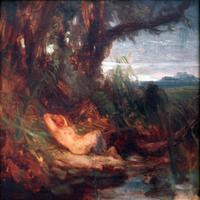
Sleeping Faun in the Reeds
Carl Blechen