
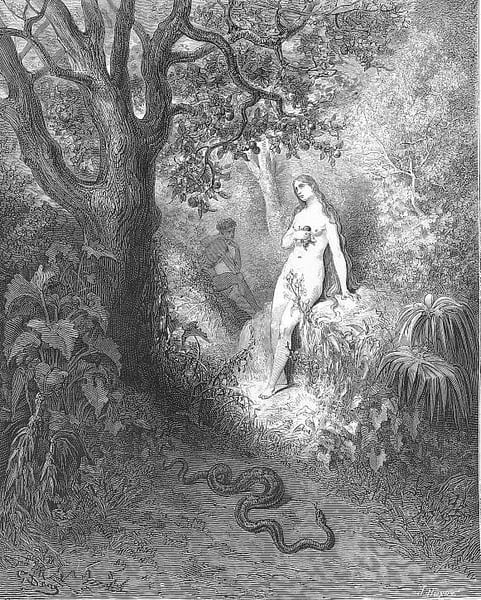
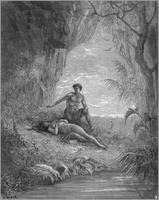
Gustave Dore sanatçısının Back to the thicket slunk The guilty serpent eseri hakkında uzman analizi
Tarz: Romanticism · Tür: illustration
This analysis focuses exclusively on the provided facts: title, artist, style, and genre.
Analysis of "Back to the thicket slunk The guilty serpent" by Gustave Doré
As a work of Romanticism in the illustration genre, this piece exemplifies the movement’s core preoccupation with dramatic emotion, the sublime power of nature, and moral or narrative tension. Doré’s illustration captures a pivotal moment in a literary source (likely Milton’s Paradise Lost), but the significance here lies in how the Romantic style elevates the scene beyond mere storytelling.
What makes it significant within its style and period:
-
The Romantic Sublime: The title’s action—the serpent slinking back into the thicket—is not a static depiction but a moment charged with guilt and concealment. Doré’s treatment of the “thicket” would be rendered with dense, expressive lines and deep chiaroscuro, typical of Romantic illustration. The wilderness becomes an active, almost malevolent presence, dwarfing the figure and emphasizing humanity’s (or here, the serpent’s) place within an overwhelming, morally charged universe. This aligns with Romanticism’s fascination with the sublime—awe mixed with terror.
-
Narrative Power in Illustration: Doré’s genius lay in his ability to compress complex literary narratives into a single, emotionally potent image. As an illustration, this work does not merely accompany text; it stands as an independent dramatic tableau. The Romantic artist’s goal was to make the viewer feel the serpent’s guilt and the oppressive atmosphere of the forest. The choice of a key transition—“back to the thicket slunk”—freezes a fleeting, furtive movement, turning it into an emblem of betrayal and consequence.
-
Technical Virtuosity: While not explicitly stated in the facts, the Romantic illustration genre under Doré demanded meticulous draftsmanship. The significance here is how the style uses light and shadow (often through wood engraving) to create a sense of depth and psychological weight. The “guilty serpent” is not just a creature but a symbol of fallen grace, and Doré’s ability to convey that emotional weight through linework and composition is a hallmark of Romantic illustration’s impact.
In summary, the artwork is significant as a quintessential Romantic illustration: it transforms a literary moment into a visually charged exploration of guilt, nature’s might, and moral drama, using the period’s characteristic intensity and narrative focus.
Görsel olarak benzer
İlişkili kompozisyon ve renk paletine sahip 20 eser
The savoury pulp they chew, and in the rind, Still as they thirsted, scoop the brimming
Gustave Dore
They heard, And from His presence hid themselves amoung The thickest trees
Gustave Dore
Diana and Actaeon
Thomas Gainsborough
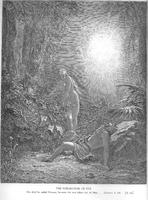
The Creation of Eve
Gustave Dore
Nymph by the fountain
Arnold Böcklin
Adam and Eve Before the Tree of Knowledge
Jan Saenredam
Pan und die Nymphen
Johann Wilhelm Schirmer
By the Riverbank
Hermann David Salomon Corrodi
So parted they the Angel up to heaven From the thick shade, and Adam to his bower
Gustave Dore
The Spring of Love
Arnold Böcklin
Eastward amoung those trees, what glorious shape Comes this way moving
Gustave Dore
Adam and Eve
Gustave Dore
Nymphs bathing
Jan Brueghel the Elder
Water
Jan Brueghel the Elder
Syrinx fleeing from the onslaught of Pan
Arnold Böcklin
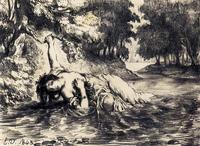
The Death of Ophelia
Eugene Delacroix
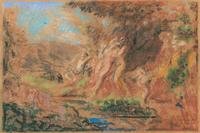
“Satyre et nymphe avec amour dans un bois”,
Ker-Xavier Roussel
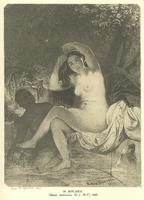
Bathsheba
Taras Shevchenko
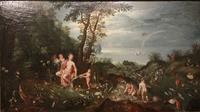
La Mer Et Ses Productions
Jan Brueghel the Elder
Untitled
Paul Ranson