
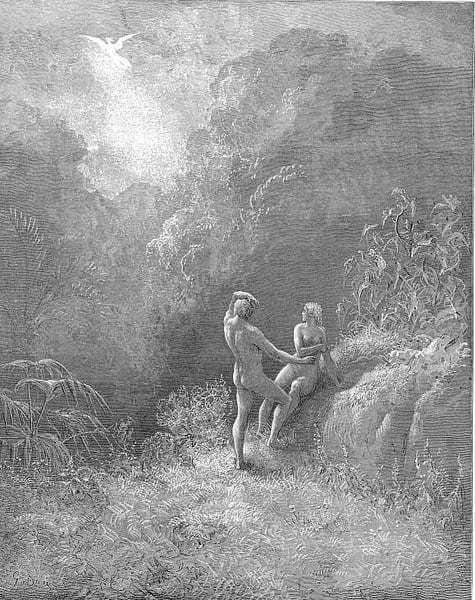
So parted they the Angel up to heaven From the thick shade, and Adam to his bower
Details
Expert analysis of Gustave Dore’s So parted they the Angel up to heaven From the thick shade, and Adam to his bower
Style: Romanticism · Genre: illustration
Expert Analysis: Gustave Doré’s So parted they the Angel up to heaven / From the thick shade, and Adam to his bower
Context and Subject
This illustration captures the poignant final lines of John Milton’s Paradise Lost (Book XII, lines 641–642), where the Archangel Michael departs after leading Adam and Eve out of Eden, and Adam retires to his bower. Doré’s composition visualizes both the cosmic and intimate dimensions of this moment—the angel’s ascent into heaven and Adam’s solitary return to mortal life.
Significance within Romanticism
Doré’s work epitomizes Romanticism’s fascination with the sublime, the supernatural, and human emotional extremes. The scene is bathed in a dramatic chiaroscuro: the angel’s luminous form dissolves into a radiant, heavenly light above, while the thick, dark foliage of Eden’s border channels the viewer’s eye downward to the hunched, shadowed figure of Adam. This stark contrast between divine brilliance and earthly gloom underscores the irrevocable loss of paradise. The Romantic ideal of nature as a mirror of human emotion is evident—the dense, brooding forest echoes Adam’s grief, while the open sky suggests a transcendent, unreachable realm.
Artistic Technique and Genre
As an illustration, Doré’s engraving is masterful in narrative efficiency. He condenses Milton’s epic into a single, iconic frame: the angel’s parting gesture, Adam’s bowed posture, and the dramatic lighting all convey the poem’s themes of obedience, despair, and the human condition. The composition exploits the verticality of the page—heaven above, earth below—creating a visual metaphor for the chasm between the divine and the fallen. Doré’s use of linear density (fine cross-hatching in the shadows) vs. open, glowing spaces (the angel’s trail) demonstrates his technical virtuosity and ability to evoke atmosphere.
Why It Matters
Doré’s Paradise Lost illustrations (1866) are among the most celebrated visual interpretations of Milton’s work. This particular plate stands out for its emotional restraint and implicit tragedy: rather than depicting Adam and Eve’s expulsion or the wrathful angel, Doré focuses on the quiet aftermath—a solitary man turning toward a life of labor and loss. The image captures the Romantic sensibility that elevates personal grief and the sublime power of nature over didactic moralizing, marking it as a definitive example of how 19th-century visual art engaged with literary and spiritual themes.
Visually similar
20 works with related composition and palette
They heard, And from His presence hid themselves amoung The thickest trees
Gustave Dore
Adam and Eve
Gustave Dore
Eastward amoung those trees, what glorious shape Comes this way moving
Gustave Dore
The Creation of Eve
Gustave Dore
Skinny Dip
Frank Mason
Back to the thicket slunk The guilty serpent
Gustave Dore
Bathing nymphs
Carl Spitzweg
Pasiphae and the Bul
Gustave Moreau
Diana and Actaeon
Thomas Gainsborough
The savoury pulp they chew, and in the rind, Still as they thirsted, scoop the brimming
Gustave Dore
“Satyre et nymphe avec amour dans un bois”,
Ker-Xavier Roussel
Nymph by the fountain
Arnold Böcklin
At Nature's Mirror
Ralph Blakelock
Hylas and the Nymphs
Karl Bryullov
Landscape with Nymphs
Jan Dirksz Both
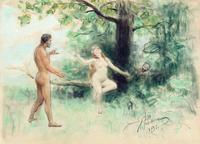
Temptation
Ilya Repin
Bidadari Mandi
Basuki Abdullah
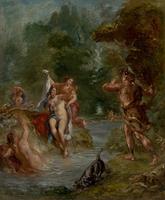
The Summer Diana Surprised by Actaeon
Eugene Delacroix
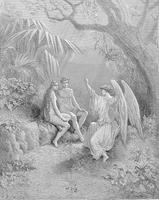
To whom the winged Hierarch replied O Adam, one Almighty is, from whom All things proceed
Gustave Dore
Sleeping Faun in the Reeds
Carl Blechen