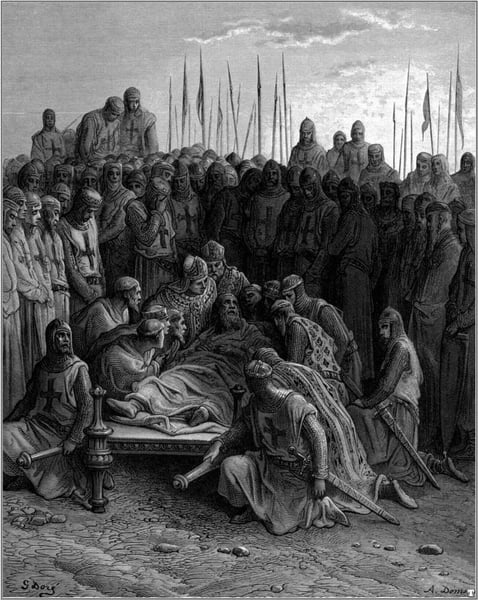
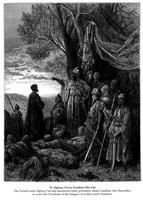
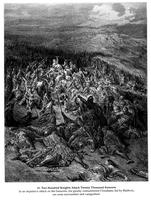
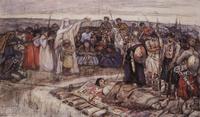
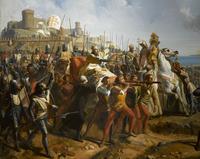
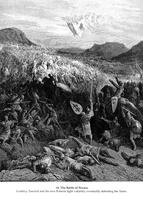
Gustave Doré’s Death of Baldwin I the Latin King of Jerusalem is a quintessential example of Romantic illustration, a genre in which Doré excelled by transforming book plates into emotionally charged, epic tableaux. The work’s significance lies in how it harnesses the core Romantic preoccupations—heroic death, historical melodrama, and the sublime—within the confined space of a printed illustration.
Doré’s composition typically centers on the dying king, bathed in stark chiaroscuro that heightens the solemnity and pathos of the moment. Baldwin I, the first crowned Latin ruler of Jerusalem, is shown not as a triumphant conqueror but as a mortal facing his end. This aligns with Romanticism’s fascination with the grandeur of suffering and the transience of power. The illustration genre, often dismissed as secondary, is here elevated to a narrative equal to history painting: Doré’s meticulous cross-hatching and theatrical lighting guide the viewer’s eye across the deathbed, the mourning attendants, and the architectural setting, which recalls medieval manuscript illuminations and the Gothic revival imagery beloved by the Romantics.
What makes this work particularly significant is its role in popularizing crusader history for a 19th‑century audience. Doré’s illustrations for books such as The History of the Crusades (often accompanying texts by Joseph François Michaud) became definitive visual references. The Death of Baldwin I encapsulates the Romantic ideal of the noble, solitary hero—a king who dies in the Holy Land, far from home, underscoring the themes of sacrifice, religious devotion, and the epic scale of the Crusades. Doré’s ability to merge historical authenticity (based on textual descriptions) with dramatic, almost operatic intensity marks this as a masterpiece of Romantic illustration, proving that even a small-scale work can achieve the emotional sweep of a monumental oil painting.