
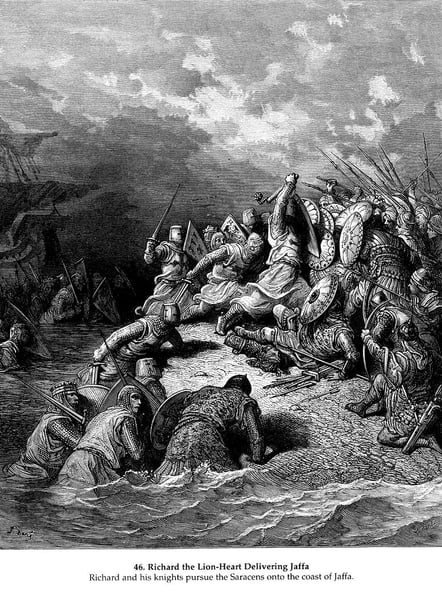
Richard I the Lionheart delivering Jaffa
Dettagli
Analisi esperta di Richard I the Lionheart delivering Jaffa di Gustave Dore
Stile: Romanticism · Genere: illustration
Expert Analysis: "Richard I the Lionheart delivering Jaffa" by Gustave Doré
Style and Period Context
Gustave Doré, a master of Romantic illustration, brings to this work the movement’s hallmark intensity: dramatic chiaroscuro, dynamic composition, and an emotional focus on heroic sacrifice. Romanticism (late 18th–19th century) prized individual valor, medieval nostalgia, and the sublime power of nature and conflict—all of which converge in this scene.
Visual and Thematic Significance
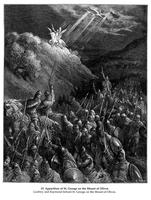
The artwork depicts a legendary moment from the Third Crusade (1191), when King Richard I of England—known as the Lionheart—personally led a counterattack to recapture the port of Jaffa from Saladin’s forces. Doré seizes the climactic instant: Richard, mounted on a rearing horse, charges into a maelstrom of Saracen warriors, his sword raised and his figure silhouetted against a stormy sky. The composition thrusts the viewer into the chaos—bodies tumble, horses rear, and wind-whipped banners frame the action.
Doré’s skill as an illustrator is evident in his meticulous cross-hatching and use of light to emphasize Richard’s armor, creating a chiaroscuro effect that isolates the king as a beacon of courage. The exaggerated muscularity of horses and fighters, the swirling drapery, and the bleak, rocky terrain all amplify the Romantic ideal of the individual hero defying overwhelming odds. This is not a dry historical record but a visual epic—a celebration of chivalric virtue, martial prowess, and the nobility of crusading zeal.
Significance within Romanticism and Illustration
Doré’s print stands as a prime example of how Romanticism transformed book illustration into high art. Unlike mere decoration, this image functions as a narrative crescendo: it condenses a complex military engagement into a single, emotionally charged tableau. The work also reflects the 19th-century fascination with medieval history (spurred by Sir Walter Scott’s novels and a resurgence of Gothic aesthetic) and the Romantic conviction that great men shape history through personal bravery.
Technically, Doré’s engraving style—with its deep shadows, flamelike lines, and dense detail—influenced later illustrators and even cinematic storytelling. Here, the composition’s diagonal thrust and Leonardesque chaos prefigure the dynamic battle scenes of Hollywood epics.
Conclusion
“Richard I the Lionheart delivering Jaffa” is significant not only as a masterwork of Romantic illustration but also as a visual mythmaking artifact. Doré transforms a historical episode into a universal symbol of heroic leadership, blending factual detail with theatrical grandeur. It encapsulates Romanticism’s core belief: that art can capture the sublime in human struggle, and that the past, when vividly reimagined, inspires the present.
Museum / Gallery
Visivamente simili
20 opere con composizione e palette affini
The Battle of Dorylaeum
Gustave Dore
The Battle of Arsuf
Gustave Dore
Two Hundred Knights Attack Twenty Thousand Saracens
Gustave Dore
The Battle of Nicaea in 1097
Gustave Dore
The Battle of Antioch
Gustave Dore
Peter the Hermit Preaching the Crusade
Gustave Dore
Confession
Gustave Dore
Gaining Converts
Gustave Dore
Saint Olav at the Battle of Stiklestad
Peter Nicolai Arbo
Battle of Antioch
Gustave Dore
The Crusaders Crossing Mount Taurus
Gustave Dore
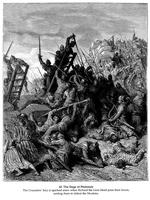
The Siege of Ptolemais
Gustave Dore
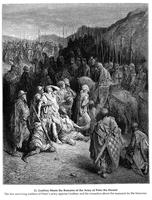
Godfrey Meets the Remains of the Army of Peter the Hermit
Gustave Dore
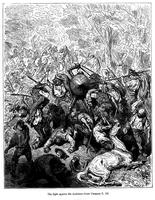
Don Quixote
Gustave Dore
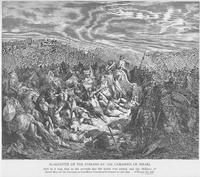
The Israelites Slaughter the Syrians
Gustave Dore
Don Quixote
Gustave Dore
Don Quixote
Gustave Dore
Christ Taken Captive
Albrecht Durer
Don Quixote
Gustave Dore
Apparition of St. George on the Mount of Olives_GustaveDore_sqs__crusades_george_mt_olives__xyz32728.gif
Gustave Dore