
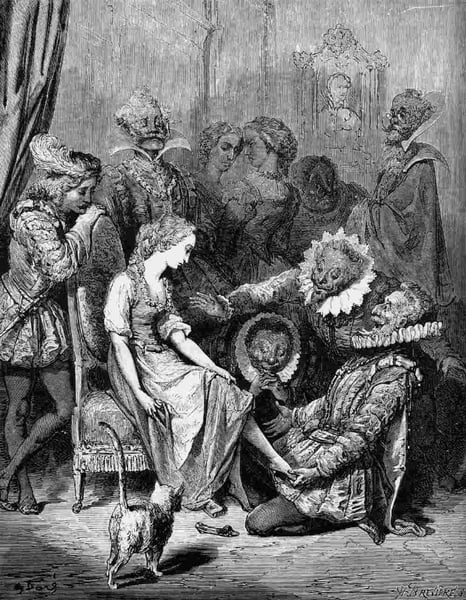
He Perceived That Her Little Foot Slid In Without Trouble
Details
Expert analysis of Gustave Dore’s He Perceived That Her Little Foot Slid In Without Trouble
Style: Romanticism · Genre: illustration
Expert Analysis of "He Perceived That Her Little Foot Slid In Without Trouble" by Gustave Doré
This work is an illustration by the prolific French artist Gustave Doré, executed within the stylistic framework of Romanticism and belonging to the genre of illustration. While the specific literary source is not explicitly stated, the title—a narrative snippet—points to a moment of delicate, almost voyeuristic observation, a hallmark of Doré’s approach to visual storytelling. The piece derives its significance from how it embodies key Romantic ideals while elevating the illustration genre to a fine art.
Significance within Romanticism
Romanticism prized intense emotion, the sublime, and the drama of human experience. Doré channels these through a masterful use of chiaroscuro—the stark contrast between light and shadow—which heightens the tension of the scene. The act of a foot sliding “without trouble” suggests a quiet, intimate transgression or secret entrance, an ordinary moment charged with underlying narrative weight. This aligns with Romanticism’s fascination with the psychological, the hidden, and the emotionally charged instant. Doré’s intricate linework and atmospheric depth immerse the viewer in a world that is both familiar and otherworldly, a common Romantic strategy to evoke awe or suspense.
Significance as an Illustration
Doré revolutionized book illustration by treating it not as mere decoration but as a powerful interpretative companion to literature. In this piece, the composition directs the eye to the subtle action—the foot—while the surrounding darkness implies a larger, perhaps ominous context. The genre of illustration allowed Doré to merge visual art with narrative, making complex stories accessible to a broad public. His work here is technically virtuosic: every fold of fabric, shadow, and architectural detail is rendered with precision, yet the overall effect is one of fleeting, dreamlike suspense. This balance of realism and romantic atmosphere is why Doré’s illustrations remain definitive for works like Dante’s Divine Comedy, Milton’s Paradise Lost, and countless fairy tales and adventure novels.
Conclusion
“He Perceived That Her Little Foot Slid In Without Trouble” stands as a testament to Doré’s ability to capture a single, pivotal moment with dramatic intensity. It is significant because it demonstrates how Romantic illustration can transform a descriptive text into a vivid, emotional experience, using light, shadow, and meticulous detail to suggest a story beyond the frame. Doré’s influence on later narrative artists—from cinema to graphic novels—underscores the lasting power of this approach.
Visually similar
20 works with related composition and palette
Maria Stuart’s Abschied von ihren Getreuen
Wilhelm von Kaulbach
Don Quixote
Gustave Dore
Faust meeting Marguerite
Eugene Delacroix
Don Quixote
Gustave Dore
Don Quixote
Gustave Dore
Don Quixote
Gustave Dore
How they break her barrel
Francisco Goya
Taste in High Life
William Hogarth
Mrs. Sextus consoles herself with a Little Party
John Leech
Nuccia accepts Meo Patacca for her husband (Plate 52/52)
Bartolomeo Pinelli
Cinderella
Gustave Dore
Burning of William White, a Priest, Norwich, England, AD 1428
Jan Luyken
Francis I and the Duchess of Etampes
Richard Parkes Bonington
Don Quixote
Gustave Dore
Don Quixote
Gustave Dore
James I and his royal progeny
Charles Turner
Don Quixote
Gustave Dore

Charles VI and Odette de Champdivers
Eugene Delacroix
The lineage
Francisco Goya
Reading for the Cardinal
Enrico Nardi