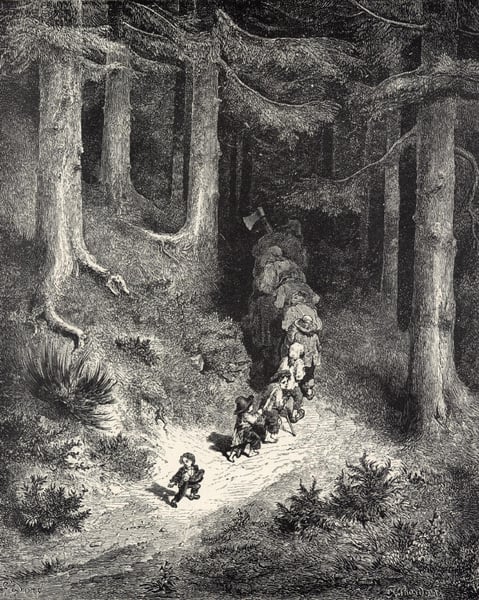
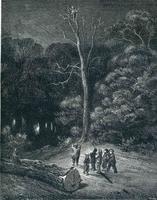
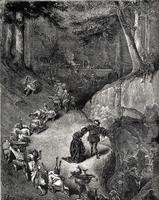
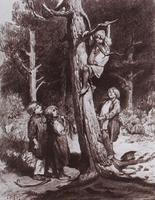
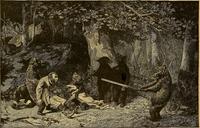
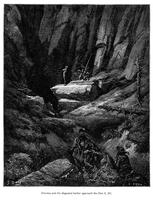
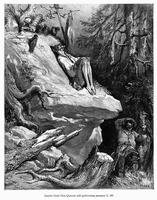
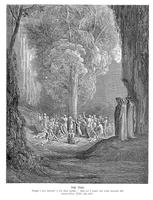
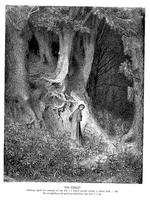
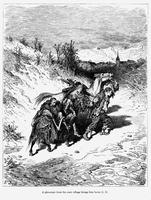
Gustave Doré’s Hop-o’-My-Thumb is a quintessential example of Romantic illustration, a genre in which the artist excelled by marrying vivid narrative drama with technical virtuosity. As a work of Romanticism, this illustration embodies the movement’s emphasis on emotion, imagination, and the supernatural—qualities that Doré amplified through his masterful use of light and shadow. The scene likely captures a moment of peril or wonder from the classic fairy tale, with Doré’s characteristic cross-hatching and dramatic chiaroscuro heightening the tension and evoking a sense of mystery.
What makes this piece significant within the Romantic period is how it elevates illustration from mere accompaniment to a powerful, standalone storytelling medium. Doré’s ability to convey complex psychological states and atmospheric depth aligns with Romanticism’s obsession with the sublime and the grotesque. Here, the tiny protagonist—literally a “thumb-sized” child—is set against a vast, often menacing landscape, emphasizing human vulnerability and resilience. This contrast between scale and emotion is a hallmark of Romantic art, and Doré’s illustration not only serves the narrative but also invites viewers to experience the tale’s underlying themes of courage and survival. In the broader context of Romanticism, Hop-o’-My-Thumb stands as a testament to Doré’s influence in shaping how illustrated literature could evoke the same visceral awe as painting or poetry.