
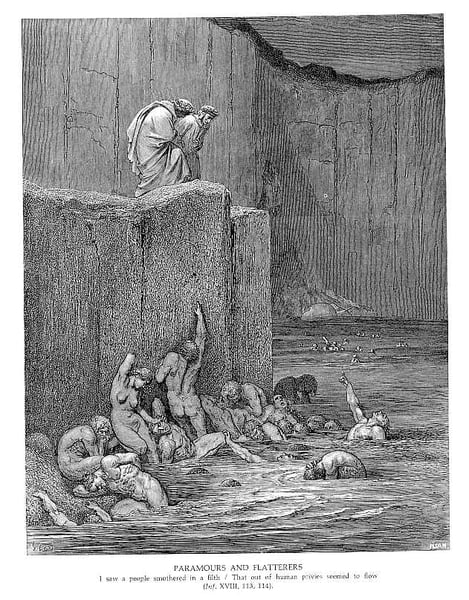
Expertenanalyse zu Gustave Dores Paramours and Flatterers
Stil: Romanticism · Genre: illustration
As an expert in art history, I will analyze "Paramours and Flatterers" by Gustave Doré strictly within the parameters provided: the artwork’s style (Romanticism) and genre (illustration).
Significance within Romanticism
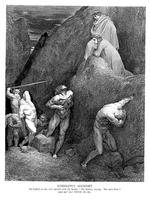
This work exemplifies the Romantic fascination with intense emotion, moral allegory, and the sublime—even the grotesque sublime. Doré’s illustration captures a visceral scene of damnation or punishment, likely drawn from Dante’s Inferno (though the facts do not specify the source). The Romantic style here manifests in the dramatic chiaroscuro (extreme contrast of light and shadow), the turbulent composition, and the contorted, expressive figures that convey psychological torment. Doré’s handling of the human form—twisted, struggling, and stripped of idealization—reflects Romanticism’s move away from Neoclassical restraint toward raw, individual sensation.
Significance as an Illustration
Doré elevates illustration from mere accompaniment to a distinct narrative art. His precise, cross-hatched linework and masterful control of tonal range create a scene that is both legible as a story and powerful as a standalone picture. In "Paramours and Flatterers," the title itself points to a moral hierarchy of sin, and Doré’s illustration clarifies that hierarchy through visual cues: the tangled bodies, the grimacing faces, and the oppressive darkness. It demonstrates how illustration in the Romantic period could serve not only to visualize a text but also to amplify its emotional and ethical weight.
Overall Significance
The work is significant because it fuses Romanticism’s emotional intensity with the illustrative tradition, producing an image that is at once literary, symbolic, and deeply moving. Doré’s ability to translate abstract vices (paramours, flatterers) into a concrete, nightmarish reality showcases Romanticism’s power to make the invisible—sin, damnation, despair—visceral. This piece stands as a reminder that illustration, in the hands of a Romantic master, is not a secondary art but a primary vehicle for exploring the darkest corners of human experience.
Visuell ähnlich
20 Werke mit ähnlicher Komposition und Farbpalette
The Inferno, Canto 18
Gustave Dore
Forgers
Gustave Dore
Geri Del Bello
Gustave Dore
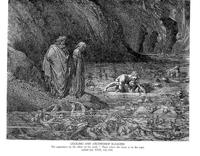
Ugolino and Archbishop Ruggieri
Gustave Dore
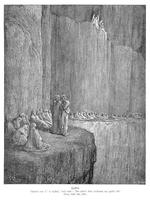
Sapia
Gustave Dore
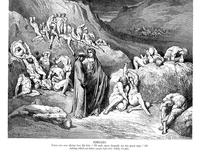
Forgers II
Gustave Dore
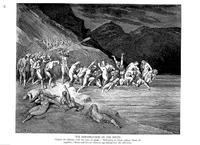
The Embarkation of the Souls
Gustave Dore
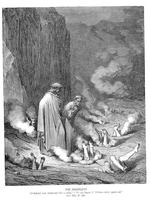
The Punishment of the Simonists
Gustave Dore
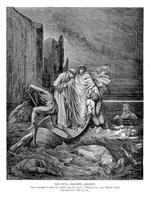
The Styx--Philippo Argenti
Gustave Dore
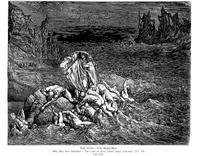
The Styx--The Irascible
Gustave Dore
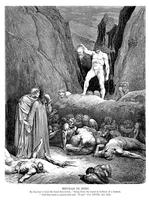
Bertram De Born
Gustave Dore
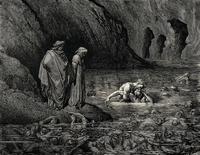
The Inferno, Canto 32
Gustave Dore
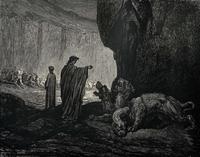
The Inferno, Canto 6
Gustave Dore
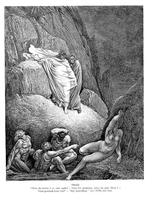
Thais
Gustave Dore
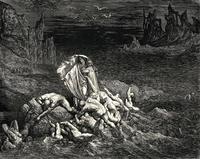
The Inferno, Canto 7
Gustave Dore
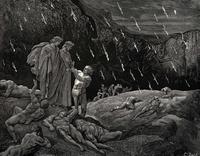
The Inferno, Canto 15
Gustave Dore
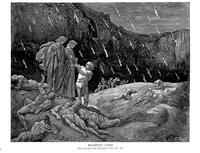
Brunetto Latini
Gustave Dore
The Mountain's Foot
Gustave Dore
Sower of Discord
Gustave Dore
Schismatics--Mahomet
Gustave Dore