
Analisi esperta di The Inferno, Canto 12 di Gustave Dore
Stile: Romanticism · Genere: illustration
Expert Analysis: "The Inferno, Canto 12" by Gustave Doré
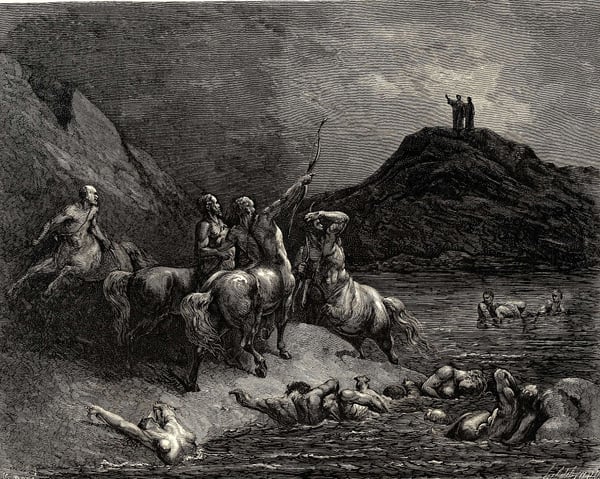
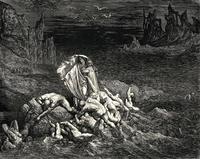
Gustave Doré’s illustration for Dante’s Inferno, Canto 12, stands as a masterful embodiment of Romanticism’s fascination with the sublime, the terrifying, and the emotionally overwhelming. Created as an illustration for the 1861 edition of Dante Alighieri’s epic poem, Doré’s work transcends mere visual accompaniment to become a powerful interpretive lens that amplifies the text’s visceral and moral gravity.
Significance within Romanticism
Romanticism prioritized intense emotion, dramatic tension, and the awe-inspiring power of nature – and of the supernatural. Doré channels all three in this scene, which depicts the seventh circle of Hell, where the violent are punished. The composition is dominated by the immense, semi-human figure of the Minotaur – a symbol of brutish rage and bestial sin – placed at the edge of a chasm. The creature’s contorted posture, bulging muscles, and shadowed face evoke both terror and pity, a hallmark of Romanticism’s interest in the psychological extremes of guilt and suffering.
Visual Drama and Composition
Doré’s dramatic chiaroscuro (extreme contrasts of light and dark) is central to the image’s impact. The Minotaur is silhouetted against a lurid, infernal glow, while deep blacks shroud the cavern walls and fleeing sinners. This light–dark tension mirrors Dante’s moral landscape of damnation and divine justice. The turbulent, rocky landscape – jagged cliffs, a boiling river of blood, and a chaotic pile of bodies – creates a sense of vertiginous scale and disorientation, placing the viewer directly in the midst of Hell’s relentless violence.
Narrative and Symbolic Depth
Doré’s illustration captures the exact moment when Virgil and Dante encounter the Minotaur, “the infamy of Crete,” who rages against them. The artist emphasizes the beast’s hybridity (man and bull) to underscore the degradation of human reason by anger – a key Romantic theme of the irrational self. The river of blood (the Phlegethon) boils in the background, teeming with sinners, while the centaurs patrolling its banks are rendered as shadowy, kinetic figures, adding to the chaos.
Legacy and Influence
Doré’s Inferno illustrations are arguably the most famous visual interpretations of Dante’s work, and Canto 12 is a prime example of why: it balances exact literary fidelity with unforgettable emotional force. The image does not merely illustrate – it interprets. By foregrounding the psychological horror of judgment and the sublime terror of divine punishment, Doré helped cement Romanticism’s visual language for the supernatural, influencing subsequent generations of illustrators, filmmakers, and fantasy artists.
In short, The Inferno, Canto 12 is significant because it transforms a moment of narrative transition into a microcosm of Romantic hell: a place where light struggles against dark, reason against instinct, and the human form becomes a monument to its own damnation.
Visivamente simili
20 opere con composizione e palette affini
The Centaurs--Nessus
Gustave Dore
The Inferno, Canto 12
Gustave Dore
The large lion hunt
Rembrandt
Elijah Destroys the Messengers of Ahaziah
Gustave Dore
Mameluke defending wounded trumpete
Théodore Géricault
The Death of Saul
Gustave Dore
Knights and horses by the sea
Giorgio de Chirico
Battle of the Imperial Cavalry
August Querfurt
Copy of Battle of Anghiari, the lost painting by Leonardo da Vinci
Peter Paul Rubens
The horse has gone
Giorgio de Chirico
The Angel Is Sent to Deliver Israel
Gustave Dore
The small lion hunt with two lions
Rembrandt
The Punishment of Antiochus
Gustave Dore
Horse and Rider Black chalk on blue paper
Titian
A cavalry fight
Rembrandt
The Conversion of St. Paul
Adam Elsheimer
The Israelites Slaughter the Syrians
Gustave Dore
The Small Lion Hunt
Rembrandt
The Sibyls in the Church of St. Our Lady of Peace
Giovanni Battista Piranesi
The Inferno, Canto 7
Gustave Dore