
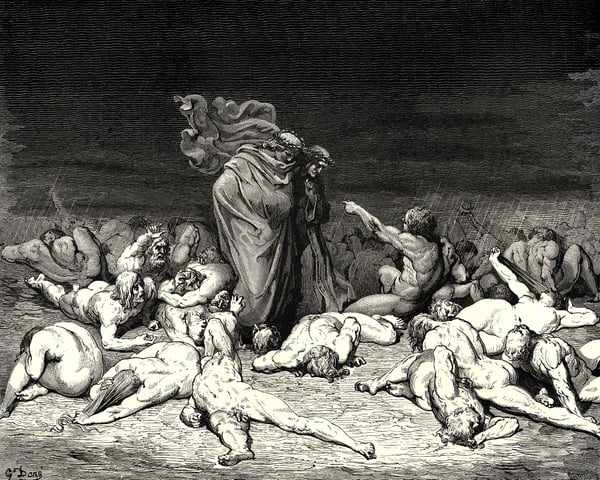
Expertenanalyse zu Gustave Dores The Inferno, Canto 6
Stil: Romanticism · Genre: illustration
Gustave Doré’s The Inferno, Canto 6 stands as a masterful testament to the Romantic period’s fascination with the sublime, the macabre, and the emotional power of literature. As an illustration for Dante Alighieri’s Divine Comedy, this work belongs to a landmark series of engravings that redefined how readers visualize the poet’s journey through Hell.
Significance within Romanticism and Illustration:
-
Dramatic Sublime and Emotional Intensity: Romanticism prized intense emotion and the awe-inspiring (often terrifying) grandeur of nature and the supernatural. Doré captures this perfectly in Canto 6, which depicts the Third Circle of Hell—the punishment of the gluttons. The scene is dominated by a torrential, freezing rain and hail, lashing down on a vast, mud-choked wasteland. The monstrous, three-headed dog Cerberus looms in the foreground, his snarling heads and clawed hands embodying raw, bestial fury. Doré uses stark chiaroscuro (extreme contrasts of light and shadow) to create a foreboding, claustrophobic atmosphere—the dim light from an unseen source barely illuminates the writhing bodies of the damned, who are half-buried in slush and howling in agony. This is not a calm, ordered Hell; it is a chaotic, visceral storm of suffering, directly appealing to the Romantic viewer’s sense of pity and terror.
-
Narrative Illustration as High Art: Doré elevated book illustration from mere decoration to a powerful narrative art form. His engravings for the Divine Comedy (first published in 1861) became his most famous achievement, selling widely and influencing visual interpretations of Dante for generations. Unlike many earlier illustrators who focused on allegorical clarity, Doré prioritized psychological impact. In this plate, the viewer is placed at the same level as the tormented souls—we are not detached observers but witnesses to their fate. The crowded composition, with Dante and Virgil standing on the muddy banks while the damned sprawl before them, draws the eye across a landscape of despair that feels both monumental and suffocating.
-
Technical Mastery and Scale: Doré’s engraving technique was renowned for its fine detail and ability to suggest vast spaces. In Canto 6, the rain is rendered as hundreds of diagonal, striated lines that seem to fall endlessly, while the mud is textured with subtle cross-hatching to give it a palpable, filthy weight. The figures of the damned are individual yet part of a mass, each posture suggesting a different stage of suffering or resignation. This meticulous craftsmanship allowed Doré to convey the epic scale of Dante’s Hell—a cosmic, eternal punishment—within the intimate format of a book page.
-
Influence on Popular Culture: Doré’s illustrations for Inferno (and his subsequent Bible illustrations) became the definitive visual template for Hell in the Western imagination. Countless film directors, video game designers, and artists have borrowed from his imagery—from the towering demons to the bleak, geometric landscapes. In Canto 6, the image of the gluttons lying in the icy mud, ceaselessly torn by Cerberus, has become iconic for its combination of grotesque physicality and spiritual hopelessness.
In sum: The Inferno, Canto 6 is significant not only as a virtuosic work of Romantic illustration but as a cultural milestone that fused literary narrative with indelible visual drama. Doré’s ability to transform Dante’s abstract poetry into a palpable, terrifying reality—while maintaining the Romantic ideals of awe, emotion, and the sublime—ensures this artwork remains a benchmark for how we imagine the punishments of Hell.
Visuell ähnlich
20 Werke mit ähnlicher Komposition und Farbpalette
The Gluttons--Ciacco
Gustave Dore
Forgers II
Gustave Dore
The Avaricious
Gustave Dore
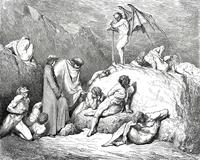
The Inferno, Canto 28
Gustave Dore
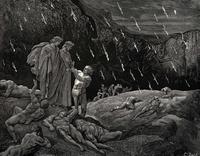
The Inferno, Canto 15
Gustave Dore
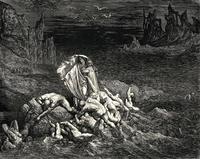
The Inferno, Canto 7
Gustave Dore
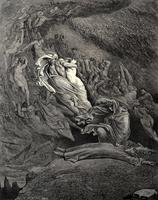
The Inferno, Canto 5
Gustave Dore
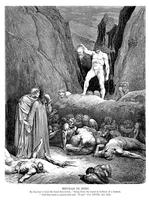
Bertram De Born
Gustave Dore
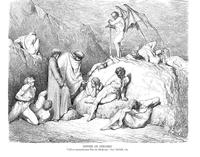
Sower of Discord
Gustave Dore
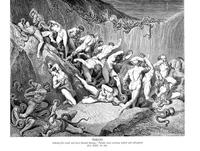
Thieves
Gustave Dore
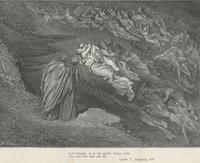
Inferno Canto 5
Gustave Dore
The Inferno, Canto 18
Gustave Dore
Geri Del Bello
Gustave Dore
Brunetto Latini
Gustave Dore
The Styx--The Irascible
Gustave Dore
The Blasphemers--Capaneus
Gustave Dore
The Embarkation of the Souls
Gustave Dore
The Inferno, Canto 24
Gustave Dore
The Inferno, Canto 32
Gustave Dore
Schismatics--Mahomet
Gustave Dore