
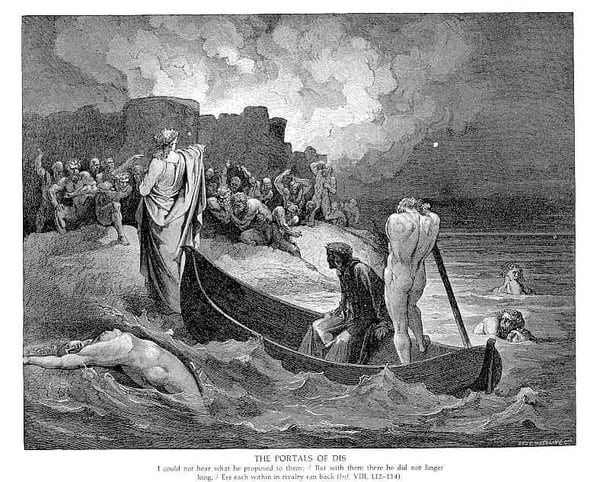
Expertenanalyse zu Gustave Dores The Portals of Dis
Stil: Romanticism · Genre: illustration
Analysis of "The Portals of Dis" by Gustave Doré
Gustave Doré’s The Portals of Dis stands as a masterful illustration within the Romantic tradition, capturing the sublime terror and infernal grandeur of Dante’s Inferno. Executed in the 1860s as part of Doré’s celebrated series for the Divine Comedy, this work exemplifies Romanticism’s fascination with the supernatural, the grotesque, and the overwhelming power of nature—here, a nature twisted into architectural and diabolical forms.
Visual and Thematic Significance
The composition centers on the towering, fortress-like gates of the city of Dis, the lower circle of Hell. Doré employs dramatic chiaroscuro, with deep, cavernous shadows contrasting against fiery, sulphurous light seeping from beyond the gates. This extreme contrast is a hallmark of Romantic painting, intended to evoke an emotional response of awe and dread—what Edmund Burke termed the “sublime.” The gates themselves are vast and brooding, their cyclopean masonry and jagged lines suggesting an ancient, inhuman scale. Figures of Dante and Virgil stand small at the foreground, dwarfed by the architecture, reinforcing humanity’s insignificance before the divine (and demonic) order.
Romantic Themes and the Role of the Illustration
Doré’s decision to illustrate Dante’s text aligns with Romanticism’s revival of medieval and Gothic sources. The gates are not merely physical barriers but psychological thresholds, representing the impossibility of reason (Virgil) alone to overcome sin without divine grace. The inclusion of the fallen angels, the Furies, and the Gorgon Medusa within the scene (as described in Canto IX) is handled with spectral restraint—figures emerge from the darkness like nightmares half-formed. This technique prioritizes suggestion over explicit horror, a key Romantic device that engages the viewer’s imagination.
Moreover, the illustration transcends mere visual accompaniment; it becomes an independent work of art that amplifies the poem’s emotional intensity. Doré’s lines are at once precise and fluid, his cross-hatching creating a texture that is both gritty and ethereal. The sky, if it can be called sky, is a void of smoldering ochre and black, a Romantic vision of a world stripped of natural light and hope.
Significance within Doré’s Oeuvre and the Romantic Movement
The Portals of Dis is significant for its synthesis of literary interpretation and pictorial drama. Doré’s illustrations for the Divine Comedy were among the most influential of the 19th century, shaping how generations imagined Dante’s Hell. In this specific plate, Doré achieves what Romanticism prized above all: the ability to make the invisible, terrifying, and transcendent visible. The image is not merely illustrative but interpretive—it emphasizes the moment when Virgil and Dante are nearly turned back, a crisis of faith and resolve that resonates with Romantic anxieties about reason, doubt, and the unknown.
Today, this illustration remains a touchstone for the visual culture of the Romantic sublime, demonstrating how illustration, often considered a secondary genre, can achieve the full emotional and intellectual weight of high art.
Visuell ähnlich
20 Werke mit ähnlicher Komposition und Farbpalette
The Inferno, Canto 8
Gustave Dore
The Styx--Philippo Argenti
Gustave Dore
The Styx--Phlegyas
Gustave Dore
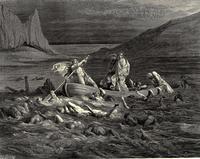
The Inferno, Canto 8
Gustave Dore
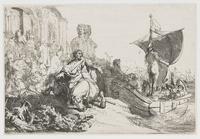
The ship of fortune
Rembrandt
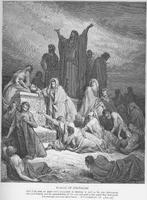
The Plague of Jerusalem
Gustave Dore
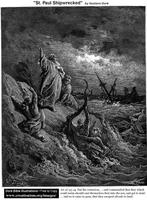
St. Paul Shipwrecked
Gustave Dore
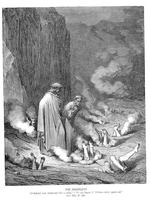
The Punishment of the Simonists
Gustave Dore
St. Paul At Ephesus
Gustave Dore
Odysseus Lands at Beach of Hades
Theodoor van Thulden
Evangelist John Exiled on Patmos, AD 97
Jan Luyken
Abishai Saves David's Life
Gustave Dore
Ugolino and Archbishop Ruggieri
Gustave Dore
A Huge Angel Stands Atop Noah's Ark, Its Back Turned Towards
Wilhelm von Kaulbach
The Embarkation of the Souls
Gustave Dore
The Inferno, Canto 7
Gustave Dore
A Famine in Samaria
Gustave Dore
The Miraculous Draught Of Fishes
Gustave Dore
The Courage of a Mother
Gustave Dore
The Styx--The Irascible
Gustave Dore