The Couple (A Holy Family)
Details
Expert analysis of Marc Chagall’s The Couple (A Holy Family)
Style: Expressionism · Genre: genre painting
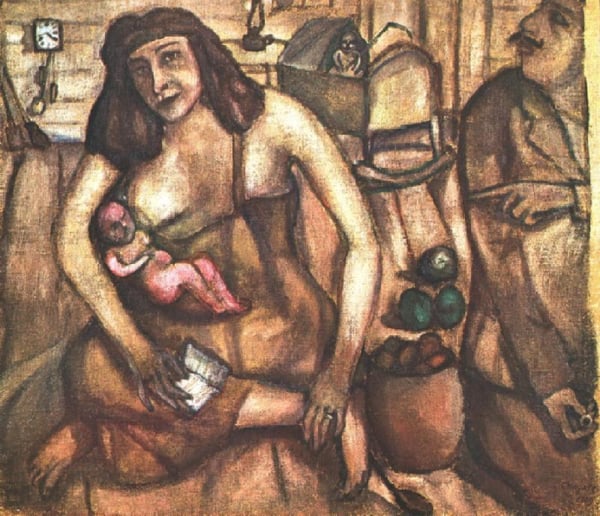
"The Couple (A Holy Family)" (1909) offers a raw, grounded glimpse into Marc Chagall’s early artistic vision, distinct from the whimsical, floating compositions of his later career. Painted during his formative years in Russia, the work anchors the divine in the soil of everyday shtetl life. The composition is dominated by the monumental figure of the mother, rendered in heavy, earthen ochres and browns that suggest a deep, visceral connection to the material world. She gazes directly at the viewer with an expression of weary resilience, cradling a nude infant whose startlingly pink flesh provides a vibrant, vulnerable contrast to the somber interior. To the right, the father figure stands partially cropped and dressed in a suit, gesturing somewhat enigmatically, creating a dynamic tension between the static domestic center and the active outside world.
The painting is a masterclass in early Expressionism, utilizing distortion and color to evoke emotional weight rather than optical realism. By subtitling the work "A Holy Family," Chagall sacralizes the profane; he elevates a scene of Russian-Jewish poverty to the status of a biblical narrative, drawing a parallel between this humble household and the iconography of Mary, Joseph, and Jesus. The rustic details—the ticking wall clock, the empty cradle in the background, and the basket of produce—serve as symbols of sustenance and the relentless passage of time. The brushwork is thick and textured, reflecting an influence of Van Gogh and Primitivism, emphasizing the roughness of their existence.
Historically, this piece is significant as a bridge between Chagall’s roots in Vitebsk and the modernism he would fully embrace in Paris. It lacks the dreamlike buoyancy of his future masterpieces, instead offering a gravity-bound, psychological portrait of the family unit. The man, dressed in modern clothing, contrasts with the timeless, almost archaic presentation of the mother and child, perhaps hinting at the friction between tradition and modernity that defined the Jewish experience in early 20th-century Eastern Europe. It is a testament to Chagall's ability to find the sacred within the struggle of ordinary life.
Museum / Gallery
Visually similar
20 works with related composition and palette
Blind Mother
Egon Schiele
Figures in a Landscape at Ampurdan
Salvador Dali
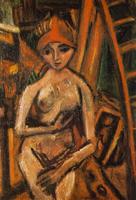
Nude with Red Turban
Bela Czobel
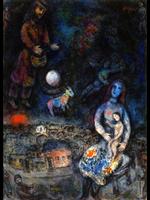
Holy Family
Marc Chagall
As Erradias
Lasar Segall
Woman Nursing Her Son
Salvador Dali
Motherhood
Max Beckmann
The Family
Egon Schiele
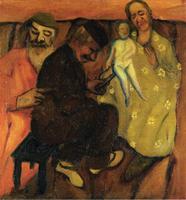
Circumcision
Marc Chagall
Woman at a Fountain
Pablo Picasso
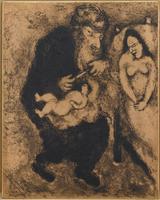
Circumcision prescribed by God to Abraham (Genesis, XVII, 10)
Marc Chagall
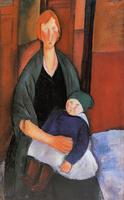
Seated Woman with Child (Motherhood)
Amedeo Modigliani
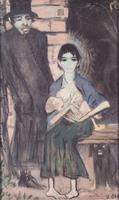
Polnische Familie
Otto Mueller
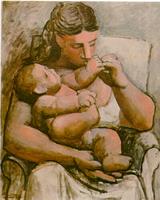
Mother and child
Pablo Picasso
Maternity
Tarsila do Amaral
Maternidade
Lasar Segall
Gypsies with Sunflowers
Otto Mueller
Mothers and Babies
Kenneth Baker
Les femmes enceintes
Grégoire Michonze
Circumcision prescribed by God to Abraham (Genesis, XVII, 10)
Marc Chagall