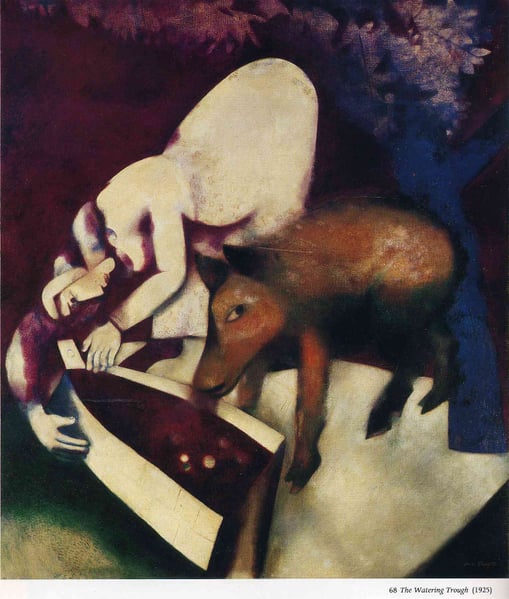
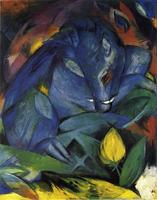
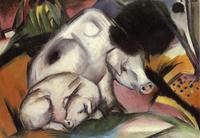
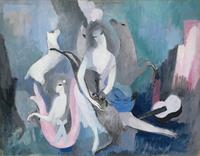
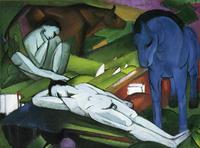
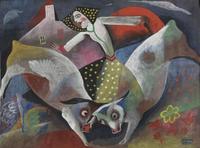
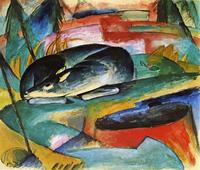
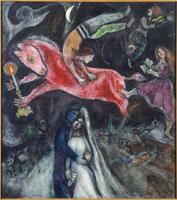
"The Watering Trough" by Marc Chagall is a significant work within the Cubist movement because it demonstrates how the style—typically associated with still lifes, portraits, or urban subjects—could be applied to a genre painting of rural everyday life. While Cubism often prioritizes geometric fragmentation and multiple perspectives over narrative, Chagall’s treatment of this humble scene (watering trough) retains the genre’s focus on human activity and environment. This fusion marks a distinctive contribution to the period: it expands Cubist vocabulary beyond analytical abstraction into a more lyrical, narrative register, presaging later developments that blend formal innovation with emotional and folkloric content. The artwork thus stands as a bridge between the rigorous structure of early Cubism and the expressive, storytelling impulses that would define much of Chagall’s later career.