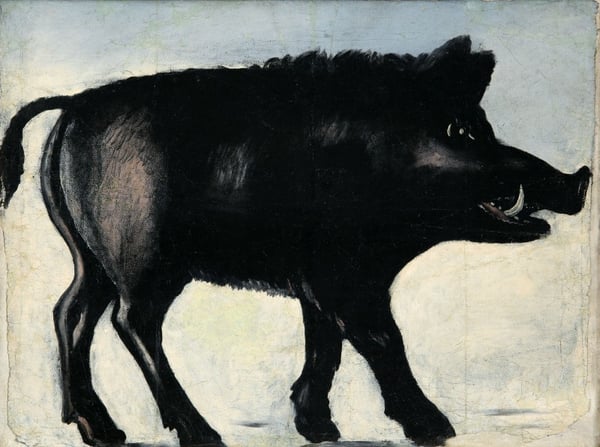
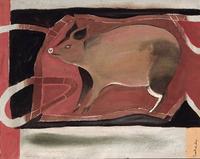
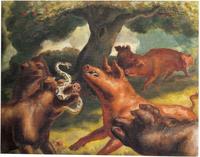
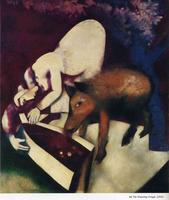
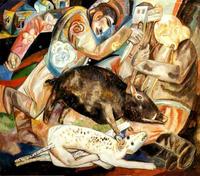
Niko Pirosmani’s Boar stands as a quintessential example of Naïve Art (Primitivism), its significance rooted in how the painting encapsulates the core tenets of the movement: a deliberate rejection of academic refinement, a raw emotional directness, and a deep connection to folk traditions. Composed with a flattened perspective and a simplicity that borders on the iconic, the work eschews naturalistic detail in favor of a bold, almost heraldic presence. This approach—typical of Pirosmani’s oeuvre—elevates a humble wildlife subject into a symbolic emblem of rustic life. The boar is rendered not as a scientific study of anatomy, but as a powerful, archetypal form, emphasizing the primal vitality that primitivist artists sought in art before the influence of formal training. In the context of Pirosmani’s career and the broader Naïve Art movement, Boar is significant for its unpretentious sincerity: it demonstrates how an untrained, self-taught artist could capture the rugged spirit of his Georgian homeland, transforming a simple animal into a timeless expression of authentic, pre-modern creativity.