Expert analysis of Marc Chagall’s Wedding
Style: Naïve Art (Primitivism) · Genre: symbolic painting
Expert Analysis of Marc Chagall’s "Wedding"
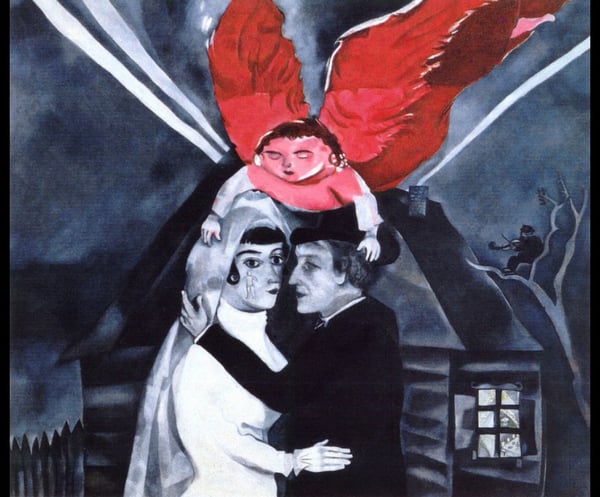
Marc Chagall’s Wedding stands as a quintessential example of Naïve Art (Primitivism), a style that deliberately eschews academic precision in favor of raw emotional expression, childlike simplicity, and folkloric charm. Within this framework, Chagall transforms the conventional marriage scene into a deeply symbolic, dreamlike tableau that transcends mere representation.
Significance within Naïve Art and Primitivism
The work’s significance lies in its masterful fusion of everyday life with the fantastical. Chagall employs a deliberately flattened perspective, bold, unmodulated colors, and an intuitive disregard for naturalistic proportions—hallmarks of the Naïve style that evoke the untutored vision of folk painters. Yet unlike purely amateur artists, Chagall consciously harnesses this primitivism to access a more universal, poetic truth. The figures in Wedding are not anchored by gravity; they float, embrace, and intertwine in a space that defies logical physics, suggesting the transcendent, joyous chaos of love itself.
Symbolic Painting and Chagall’s Visual Vocabulary
As a symbolic painting, Wedding operates on multiple interpretive levels. The central couple, often depicted in a halo of white or vibrant tones, represents not just a specific marriage but the eternal union of souls. Surrounding elements—a fiddler on a rooftop, a large bouquet, animals, and architectural fragments reminiscent of his native Vitebsk—are recurring motifs in Chagall’s work. These symbols are drawn from Jewish folklore, Russian village life, and his own autobiographical memory, creating a personal mythology that resonates universally. The floating musicians and airborne lovers speak to the artist’s belief that art should capture the ecstatic, irrational dimensions of human experience.
Lasting Impact
Chagall’s Wedding is significant because it elevates the Naïve style from simple charm to profound commentary on love, memory, and spirituality. It demonstrates how Primitivism, as practiced by a sophisticated modernist, can bypass the intellect and speak directly to the heart. The painting’s enduring appeal lies in its ability to make the familiar strange and the strange familiar—a balance that cements Chagall’s role as a pivotal figure in 20th-century art, bridging the gap between folk traditions and avant-garde innovation.
Museum / Gallery
Visually similar
20 works with related composition and palette
Untitled
Jules-Alexandre Grun
No. 5
Aubrey Beardsley
The Poet and the Angel
Mario Eloy
The Lives of Edwy
Rose O'Neill
The Three Candles
Marc Chagall
Sogno di un valzer
Leopoldo Metlicovitz
Over the town
Marc Chagall
Cover of "La Casa de los solteros" by Alberto Insua
Arturo Souto
The wedding party
Henri Rousseau
Lovers' sky
Marc Chagall
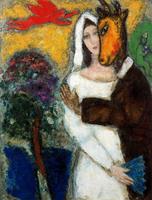
Midsummer Night's Dream
Marc Chagall
The widow
Otto Dix
Untitled
Jules-Alexandre Grun
Fusilamiento
Esteban Frances
Pieta (Revolution by Night)
Max Ernst
Lovers near Bridge
Marc Chagall
Newlywedds with Eiffel Towel in the Background
Marc Chagall
The tree of life
Marc Chagall
The Promenade
Marc Chagall
Affiche Pour Les Fêtes Du 5ème Congrès De La Corda Fratres Tenu À Bordeaux En 1907. on Distingue Des Faluches Dans Le Fond Sur Deux Étudiants Et Aussi Une Sur La Tête Du Danseur Au Premier Plan.
Leonetto Cappiello