Expert analysis of Mario Eloy’s The Poet and the Angel
Style: Expressionism · Genre: symbolic painting
Expert Analysis: "The Poet and the Angel" by Mario Eloy
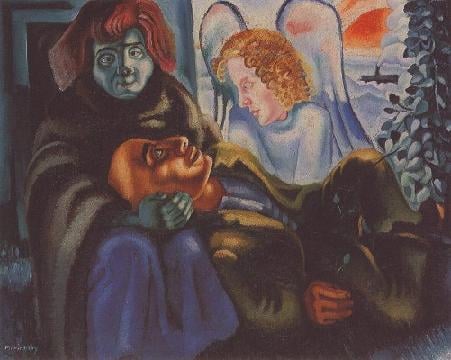
In Mario Eloy’s The Poet and the Angel, we encounter a distilled moment of Expressionist intensity, anchored in the symbolic confrontation between creative inspiration and ethereal transcendence. As a work of Expressionism, the painting eschews naturalistic representation in favor of heightened emotional force—likely achieved through distorted forms, compressed space, and a charged, dissonant color palette typical of the movement. Eloy, a key figure in Portuguese modernism, channels the angst and spiritual longing of early 20th‑century European art.
The symbolic genre here is crucial: the Poet embodies the tormented human creator, while the Angel represents a messenger of divine or irrational inspiration—a motif resonant with Expressionism’s obsession with inner truth over outer reality. The significance lies in how Eloy synthesizes these two archetypes into a single, fraught encounter. Rather than a serene visitation, the composition likely conveys struggle, reciprocity, or even a threat; the angel may be both muse and antagonist, forcing the poet to confront the sublime.
What makes this work particularly important within Expressionism is its merging of personal psychology with universal myth. Eloy’s handling of the subject refuses romantic idealization, instead pushing toward raw, subjective experience—the hallmark of Expressionist symbolism. The painting stands as a testament to the movement’s ability to render invisible, emotional states through visible, disrupted forms, and to use ancient symbolic figures (poet, angel) as vessels for modern anxiety and aspiration. In this, The Poet and the Angel is not merely a narrative scene but a visual manifesto of the artist as a tortured receptor of visions.
Genre
Style
Visually similar
20 works with related composition and palette
The Princess and the Goblin
Jessie Willcox Smith
Gyntiana - The Birth of Onionman
Jorg Immendorff
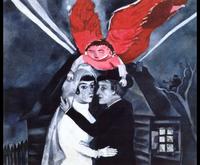
Wedding
Marc Chagall
War
Wilhelm Kotarbinski
Gorgon
Wilhelm Kotarbinski
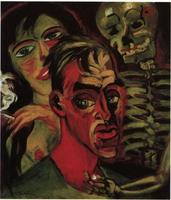
Self-Portrait with Death
Max Pechstein
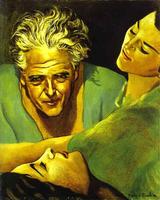
Self Portrait
Francis Picabia
Faust - 'Let Earth Be Severe, Heaven is Forgiving'
Byam Shaw
Witches' Dance
Hermann Hendrich
The Spirit of the Abyss
Wilhelm Kotarbinski
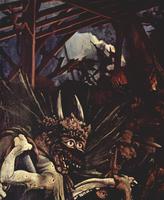
The Temptation of St. Anthony (detail)
Matthias Grünewald
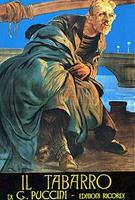
Poster De La Ópera Il Tabarro De Puccini
Leopoldo Metlicovitz
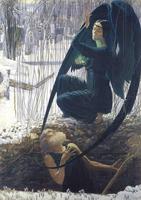
Death and the Grave Digger
Carlos Schwabe
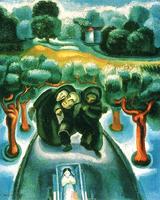
From My Window
Mario Eloy
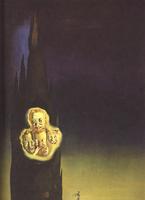
Phosphene of Laporte
Salvador Dali
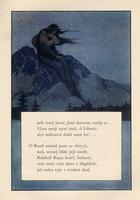
Illustration for Vyšehrad
Artuš Scheiner
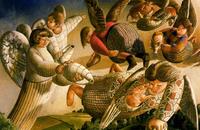
Angels of the Apocalypse
Stanley Spencer
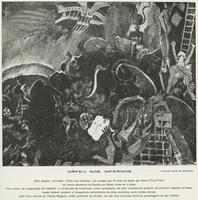
Orfeu nos Infernos
Guilherme de Santa-Rita
They spruce themselves up
Francisco Goya
Cover of the June, 1914 issue of The Masses
John French Sloan