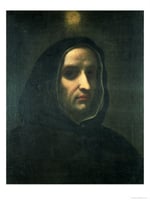
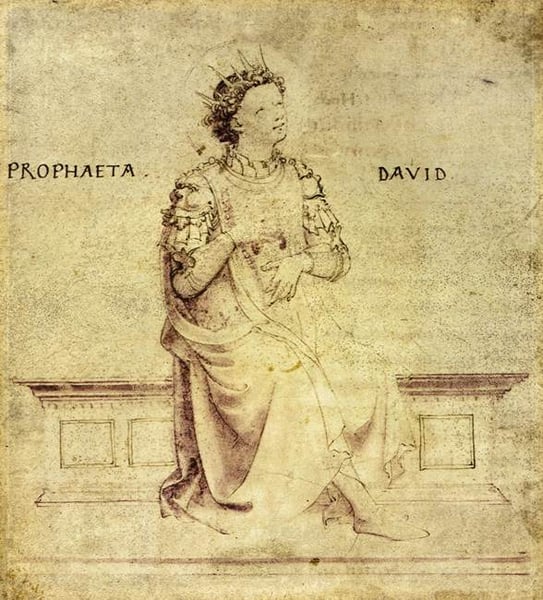
Expert analysis of Fra Angelico’s King David Playin a Psaltery
Style: Early Renaissance · Genre: religious painting
Expert Analysis of "King David Playing a Psaltery" by Fra Angelico
As an early Renaissance religious painting, this work by Fra Angelico marks a pivotal moment in the transition from medieval iconography to the naturalism and humanist clarity of the Renaissance. The subject—King David, the Old Testament musician and psalmist—is rendered with a serene, devotional grace that typifies Fra Angelico’s unique synthesis of Gothic spirituality and emerging Renaissance ideals.
Significance within the Style and Period:
-
Spiritual Clarity and Idealized Form: Fra Angelico, a Dominican friar, imbues his religious figures with an otherworldly purity. Here, David is not merely a historical king but a vessel of divine harmony, his gentle demeanor and focused expression inviting contemplation. This reflects the early Renaissance emphasis on conveying sacred narratives with accessible, emotionally resonant humanity, while still retaining the symbolic weight of medieval art.
-
Transitional Use of Space and Color: The composition likely balances a gold-leaf background (a Gothic holdover that signals the eternal, heavenly realm) with a more naturalistic handling of David’s posture and the psaltery instrument. The early Renaissance is characterized by this blend—the symbolic, timeless space of the Middle Ages meeting the emerging interest in tangible, three-dimensional form. Fra Angelico’s soft, luminous palette and delicate modeling of light and shadow (chiaroscuro) enhance the sense of physical presence while preserving a transcendent calm.
-
Musical Symbolism as Devotional Tool: David playing the psaltery underscores the period’s view of music as a metaphor for celestial order and a direct path to prayer. The instrument’s careful depiction demonstrates the early Renaissance fascination with empirical observation, yet the scene’s primary function is devotional—to inspire viewers to hear “the harmony of the spheres” and join in praise.
-
Legacy of the Early Renaissance “Painted Prayer”: This painting exemplifies Fra Angelico’s role as a bridge between the medieval tradition of the icon and the Renaissance painter’s role as a storyteller. Its significance lies in how it makes theological concepts visually intimate, using the period’s growing technical skill (e.g., perspective, drapery, naturalistic facial features) to elevate religious experience rather than merely decorate.
In sum, "King David Playing a Psaltery" is significant because it captures the early Renaissance’s core achievement: the fusion of sacred meaning with humanistic tenderness. Fra Angelico’s hand transforms a biblical figure into a timeless symbol of devotion, setting a standard for religious art that balances pictorial beauty with spiritual gravity.
Museum / Gallery
Visually similar
20 works with related composition and palette
Madonna and Child
Albrecht Durer
Sitting Mary with child
Albrecht Durer

Young Woman Fanning a fire with a bird's wing
Martin Schongauer
Kneeling woman
Rogier van der Weyden
Oriental Ruler Enthroned
Albrecht Durer
Study for 'The Knight's Dream'
Raphael
The Visitation of the Virgin to Saint Elizabeth; King Solomon in a Niche at Left
Carlo Urbino
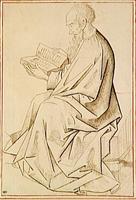
Etude of figure the evangelist
Rogier van der Weyden
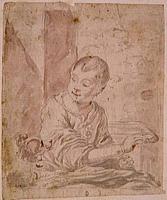
Child watching a dog
Bartolome Esteban Murillo
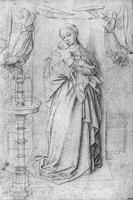
Copy drawing of Madonna by the Fountain
Jan van Eyck
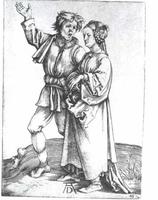
The young peasant and his wife
Albrecht Durer
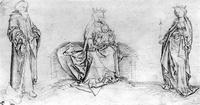
Sitting Mary with the St. Jude Thaddeus and St. Ursula
Martin Schongauer
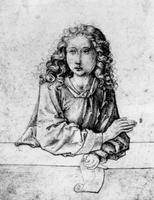
Boy with scroll
Martin Schongauer
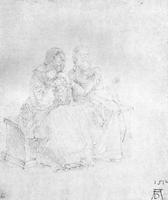
Anna selbdritt
Albrecht Durer
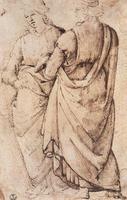
Study of Two Women
Domenico Ghirlandaio
Emblem
Adriaen van de Venne
Juno
Palma il Giovane
Portrait of a Child
Bartolome Esteban Murillo
The Fifth Wise Virgin
Martin Schongauer
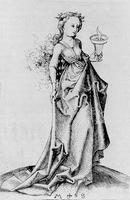
The Second Wise Virgin
Martin Schongauer